Showing posts with label publishing. Show all posts
Friday, January 3, 2014
A New Year's letter to academic publishers
My relationships with journals are rather like a bad marriage: a mixture of dependency and hatred. Part of the problem is that journal editors and academics often have a rather different view of the process. Scientific journals could not survive without academics. We do the research, often spending several years of our lives to produce a piece of work that is then distilled into one short paper, which the fond author invariably regards as a fascinating contribution to the field. But when we try to place our work in a journal, we find that it's a buyer's market: most journals are overwhelmed with more submitted papers than they can cope with, and rejection rates are high. So there is a total mismatch: we set out naively dreaming of journals leaping at the opportunity to secure our best work, only to be met with coldness and rejection. As in the best Barbara Cartland novels, for a lucky few, persistence is ultimately rewarded, and the stony-hearted editor is won over. But many potential authors fall by the wayside long before that point.
But times are changing. We are moving from a traditional "dead tree technology" model, where journals have to be expensively printed and distributed, to electronic-only media. These not only cost less to produce, but also avoid the length limits that traditionally have forced journals to be so highly selective. Alongside the technological changes, there has been rapid growth of the Open Access movement. The main motivations behind this movement were idealistic (making science available to all) and economic (escaping the stranglehold of expensive library subscriptions to closed-access journals). It's early days, but I am starting to sense that there's another consequence of the shift, which is that, as the field opens up, publishers are starting to change how they approach authors: less as supplicants, and more as customers.
In the past, the top journals had no incentive to be accommodating to authors. There were too many of us chasing scarce page space. But there are now some new boys on the open access block, and some of them have recognised that if they want to attract people to publish with them, they should listen to what authors want. And if they want academics to continue to referee papers for no reward, then they had better treat them well too.
This really is not too hard to do. I have two main gripes with journals, a big one and a little one. The big one concerns my time. The older I get, the less patient I am with organizations that behave as if I have all the time in the world to do the small bureaucratic chores that they wish to impose on me. For instance, many journals specify pointless formatting requirements for an initial submission. I really, really resent jumping through arbitrary hoops when the world is full of interesting things I could be doing. And cutting my toenails is considerably more interesting than reformatting references.
I recently encountered a journal whose website required you to enter details (name/address/email) of all authors in order to submit a pre-submission enquiry. Surely the whole point of a pre-submission enquiry is to save time, so you can get a quick decision on whether it's likely to be worth your while battling with the submission portal! There's also the horror of journals that require signatures from all authors at the point when you submit a manuscript: seems a harmless enough requirement, except that authors are often widely dispersed - on maternity leave or sailing the Atlantic - by the time the paper is submitted. The idea is to avoid fraud, of course, but like so many ethics regulations, the main effect of this requirement is to encourage honest, law-abiding people to take up forgery.
Oh, and then there are the 'invitations to review' (makes it sound so enticing, like being invited to a party), which require you to login in order to register your response – which for me invariably means selecting the option that I have forgotten my password, then looking at email to find how to update the password, meanwhile getting distracted by other email messages so I forget what I was doing, and eventually returning to the site to find it wants me now to change the password and enter mandatory contact details before it will accept my response. Well, no. I'm usually a good citizen but I'm afraid I've just stopped responding to those.
You'd think the advent of electronic submission would make life easier, but in fact it can just open up a whole new world of tiny, fiddly things that you are required to do before your paper is submitted. Each individual thing is usually fairly trivial, but they do add up. So, for instance, if you'd like your authors to suggest referees, please allow them to paste in a list. DO NOT require them to cut and paste title, forename, initial, surname, email and institution into your horrible little boxes for each of six potential referees. It all takes TIME. And we have more important things in life to be getting on with. Including doing the science that allows us to get the point of writing a paper.
Even worse, some of the requirements of journals are just historical artefacts with no more rationale than male nipples. Here's a splendid post by Kate Jeffery which in fact was the impetus for this blogpost. I thought of Kate when, having carefully constructed a single manuscript document including figures, as instructed by the Instructions for Authors, I got to the submission portal to be strictly told that ON NO ACCOUNT must the figures be included in the main manuscript. Instead, they had to be separated, not only from the manuscript, but also from their captions (which had to be put as a list at the end of the manuscript). This makes sense ONCE THE PAPER IS ACCEPTED, when it needs to be typeset. But not at the point of initial submission, when the paper's fate is undecided: it may well be rejected, and if not, it will certainly require revision. And meanwhile, you have referees tearing their hair out trying to link up the text, the Figures and their captions.
The smaller gripe is just about treating people with respect. I do have a preference for journal editors whose correspondence indicates that they are a human being and not an automaton. I've moaned about this before, in an old post describing a taxonomy of journal editors, but my feeling is that in the three years since I wrote that, things have got worse rather than better. Publishers and editors may think they make their referees happy by writing and telling them how useful their review of a paper has been – but the opposite effect is created if it is clear that this is a form letter that goes to all referees, however hopeless.It is really better to be ignored than to be sent an insincere, meaningless email - it just implies that the sender thinks you are stupid enough to be taken in by it.
So my message to publishers in 2014 is really very simple. The market is getting competitive and if you want to attract authors to send their best work to you, and referees to keep reviewing for you, you need to become more sensitive to our needs. Two journals that appear to be trying hard are eLife and PeerJ, who avoid most of the bad practices I have outlined. I am hoping their example will cause others to up their game. We are mostly very simple souls who are not hard to please, but we hate having our time wasted, and we do like being treated like human beings.
Thursday, March 21, 2013
Blogging as post-publication peer review: reasonable or unfair?
In
a previous blogpost, I criticised a recent paper claiming that playing action
video games improved reading in dyslexics. In a series of comments below the
blogpost, two of the authors, Andrea Facoetti and Simone Gori, have responded
to my criticisms. I thank them for taking the trouble to spell out their views
and giving readers the opportunity to see another point of view. I am, however,
not persuaded by their arguments, which make two main points. First, that their
study was not methodologically weak and so Current Biology was right to publish
it, and second, that it is unfair, and indeed unethical, to criticise a
scientific paper in a blog, rather than through the regular scientific
channels.
Regarding the study
methodology, as noted above, the principal problem with the study by
Franceschini et al was that it was underpowered, with just 10 participants per
group. The authors reply with an
argument ad populum, i.e. many other studies have used equally small samples.
This is undoubtedly true, but it doesn’t make it right. They dismiss the paper
I cited by Christley (2010) on the grounds that it was published in a low
impact journal. But the serious drawbacks of underpowered studies have been
known about for years, and written about in high- as well as low-impact
journals (see references below).
The response by Facoetti
and Gori illustrates the problem I had highlighted. In effect, they are saying
that we should believe their result because it appeared in a high-impact
journal, and now that it is published, the onus must be on other people to
demonstrate that it is wrong. I can appreciate that it must be deeply
irritating for them to have me expressing doubt about the replicability of
their result, given that their paper passed peer review in a major journal and
the results reach conventional levels of statistical significance. But in the
field of clinical trials, the non-replicability of large initial effects from
small trials has been demonstrated on numerous occasions, using empirical data
- see in particular the work of Ioannidis, referenced below. The reasons for
this ‘winner’s curse’ have been much discussed, but its reality is not in
doubt. This is why I maintain that the paper would not have been published if
it had been reviewed by scientists who had expertise in clinical trials
methodology. They would have demanded more evidence than this.
The response by the
authors highlights another issue: now that the paper has been published, the
expectation is that anyone who has doubts, such as me, should be responsible
for checking the veracity of the findings. As we say in Britain, I should put
up or shut up. Indeed, I could try to get a research grant to do a further
study. However, I would probably not be allowed by my local ethics committee to
do one on such a small sample and it might take a year or so to do, and would
distract me from my other research. Given that I have reservations about the
likelihood of a positive result, this is not an attractive option. My view is
that journal editors should have recognised this as a pilot study and asked the
authors to do a more extensive replication, rather than dashing into print on
the basis of such slender evidence. In publishing this study, Current Biology
has created a situation where other scientists must now spend time and
resources to establish whether the results hold up.
To establish just how
damaging this can be, consider the case of the FastForword intervention,
developed on the basis of a small trial initially reported in Science in 1996.
After the Science paper, the authors went directly into commercialization of
the intervention, and reported only uncontrolled trials. It took until 2010 for
there to be enough reasonably-sized independent randomized controlled trials to
evaluate the intervention properly in a meta-analysis, at which point it was
concluded that it had no beneficial effect. By this time, tens of thousands of
children had been through the intervention, and hundreds of thousands of
research dollars had been spent on studies evaluating FastForword.
I appreciate that those
reporting exciting findings from small trials are motivated by the best of
intentions – to tell the world about something that seems to help children. But
the reality is that, if the initial trial is not adequately powered, it can be
detrimental both to science and to the children it is designed to help, by
giving such an imprecise and uncertain estimate of the effectiveness of
treatment.
Finally, a comment on
whether it is fair to comment on a research article in a blog, rather than
going through the usual procedure of submitting an article to a journal and
having it peer-reviewed prior to publication. The authors’ reactions to my
blogpost are reminiscent of Felicia Wolfe-Simon’s response to blog-based
criticisms of a paper she published in Science: "The items you are
presenting do not represent the proper way to engage in a scientific
discourse”. Unlike Wolfe-Simon, who simply refused to engage with bloggers,
Facoetti and Gori show willingness to discuss matters further, and present
their side of the story, but they nevertheless it is clear they do not regard a
blog as an appropriate place to debate scientific studies.
I could not disagree
more. As was readily demonstrated in the Wolfe-Simon case, what has come to be
known as ‘post-publication peer review’ via the blogosphere can allow for new
research to be rapidly discussed and debated in a way that would be quite
impossible via traditional journal publishing. In addition, it brings the
debate to the attention of a much wider readership. Facoetti and Gori feel I
have picked on them unfairly: in fact, I found out about their paper because I
was asked for my opinion by practitioners who worked with dyslexic children.
They felt the results from the Current Biology study sounded too good to be
true, but they could not access the paper from behind its paywall, and in any
case they felt unable to evaluate it properly. I don’t enjoy criticising
colleagues, but I feel that it is entirely proper for me to put my opinion out
in the public domain, so that this broader readership can hear a different
perspective from those put out in the press releases. And the value of blogging
is that it does allow for immediate reaction, both positive and negative. I
don’t censor comments, provided they are polite and on-topic, so my readers
have the opportunity to read the reaction of Facoetti and Gori.
I should emphasise that I
do not have any personal axe to grind with the study's authors, who I do not
know personally. I’d be happy to revise my opinion if convincing arguments are
put forward, but I think it is important that this discussion takes place in
the public domain, because the issues it raises go well beyond this specific
study.
References
Button, K. S., Ioannidis,
J. P. A., Mokrysz, C., Nosek, B. A., Flint, J., Robinson, E. S. J., &
Munafo, M. R. (2013). Power failure: why small sample size undermines the
reliability of neuroscience. Nature Reviews Neuroscience, advance online publication.
doi: 10.1038/nrn3475
Ioannidis, J. P. A. (2005).
Why most published research findings are false. PLoS Medicine, 2(8), e124. doi:
10.1371/journal.pmed.0020124
Ioannidis, J. P. (2008).
Why most discovered true associations are inflated. Epidemiology 19(5),
640-648.
Ioannidis JP, Pereira TV,
& Horwitz RI (2013). Emergence of large treatment effects from small
trials--reply. JAMA : the journal of the American Medical Association, 309 (8),
768-9 PMID: 23443435
Saturday, March 9, 2013
High-impact journals: where newsworthiness trumps methodology
Here’s a paradox: Most scientists would give their eye teeth to get a paper in a high impact journal, such as Nature, Science, or Proceedings of the National Academy of Sciences. Yet these journals have had a bad press lately, with claims that the papers they publish are more likely to be retracted than papers in journals with more moderate impact factors. It’s been suggested that this is because the high impact journals treat newsworthiness as an important criterion for accepting a paper. Newsworthiness is high when a finding is both of general interest and surprising, but surprising findings have a nasty habit of being wrong.
A new slant on this topic was provided recently by a paper by Tressoldi et al (2013), who compared the statistical standards of papers in high impact journals with those of three respectable but lower-impact journals. It’s often assumed that high impact journals have a very high rejection rate because they adopt particularly rigorous standards, but this appears not to be the case. Tressoldi et al focused specifically on whether papers reported effect sizes, confidence intervals, power analysis or model-fitting. Medical journals fared much better than the others, but Science and Nature did poorly on these criteria. Certainly my own experience squares with the conclusions of Tressoldi et al (2013), as I described in the course of discussion about an earlier blogpost.
Last week a paper appeared in Current Biology (impact factor = 9.65) with the confident title: “Action video games make dyslexic children read better.” It's a classic example of a paper that is on the one hand highly newsworthy, but on the other, methodologically weak. I’m not usually a betting person, but I’d be prepared to put money on the main effect failing to replicate if the study were repeated with improved methodology. In saying this, I’m not suggesting that the authors are in any way dishonest. I have no doubt that they got the results they reported and that they genuinely believe they have discovered an important intervention for dyslexia. Furthermore, I’d be absolutely delighted to be proved wrong: There could be no better news for children with dyslexia than to find that they can overcome their difficulties by playing enjoyable computer games rather than slogging away with books. But there are good reasons to believe this is unlikely to be the case.
An interesting way to evaluate any study is to read just the Introduction and Methods, without looking at Results and Discussion. This allows you to judge whether the authors have identified an interesting question and adopted an appropriate methodology to evaluate it, without being swayed by the sexiness of the results. For the Current Biology paper, it’s not so easy to do this, because the Methods section has to be downloaded separately as Supplementary Material. (This in itself speaks volumes about the attitude of Current Biology editors to the papers they publish: Methods are seen as much less important than Results). On the basis of just Introduction and Methods, we can ask whether the paper would be publishable in a reputable journal regardless of the outcome of the study.
On the basis of that criterion, I would argue that the Current Biology paper is problematic, purely on the basis of sample size. There were 10 Italian children aged 7 to 13 years in each of two groups: one group played ‘action’ computer games and the other was a control group playing non-action games (all games from Wii's Rayman Raving Rabbids - see here for examples). Children were trained for 9 sessions of 80 minutes per day over two weeks. Unfortunately, the study was seriously underpowered. In plain language, with a sample this small, even if there is a big effect of intervention, it would be hard to detect it. Most interventions for dyslexia have small-to-moderate effects, i.e. they improve performance in the treated group by .2 to .5 standard deviations. With 10 children per group, the power is less than .2, i.e. there’s a less than one in five chance of detecting a true effect of this magnitude. In clinical trials, it is generally recommended that the sample size be set to achieve power of around .8. This is only possible with a total sample of 20 children if the true effect of intervention is enormous – i.e. around 1.2 SD, meaning there would be little overlap between the two groups’ reading scores after intervention. Before doing this study there would have been no reason to anticipate such a massive effect of this intervention, and so use of only 10 participants per group was inadequate. Indeed, in the context of clinical trials, such a study would be rejected by many ethics committees (IRBs) because it would be deemed unethical to recruit participants for a study which had such a small chance of detecting a true effect.
But, I hear you saying, this study did find a significant effect of intervention, despite being underpowered. So isn’t that all the more convincing? Sadly, the answer is no. As Christley (2010) has demonstrated, positive findings in underpowered studies are particularly likely to be false positives when they are surprising – i.e., when we have no good reason to suppose that there will be a true effect of intervention. This seems particularly pertinent in the case of the Current Biology study – if playing active computer games really does massively enhance children’s reading, we might have expected to see a dramatic improvement in reading levels in the general population in the years since such games became widely available.
The small sample size is not the only problem with the Current Biology study. There are other ways in which it departs from the usual methodological requirements of a clinical trial: it is not clear how the assignment of children to treatments was made or whether assessment was blind to treatment status, no data were provided on drop-outs, on some measures there were substantial differences in the variances of the two groups, no adjustment appears to have been made for the non-normality of some outcome measures, and a follow-up analysis was confined to six children in the intervention group. Finally, neither group showed significant improvement in reading accuracy, where scores remained 2 to 3 SD below the population mean (Tables S1 and S3): the group differences were seen only for measures of reading speed.
Will any damage be done? Probably not much – some false hopes may be raised, but the stakes are not nearly as high as they are for medical trials, where serious harm or even death can result from wrong results. There is concern, however, that quite apart from the implications for families of children with reading problems, there is another issue here, about the publication policies of high-impact journals. These journals wield immense power. It is not overstating the case to say that a person’s career may depend on having a publication in a journal like Current Biology (see this account – published, as it happens, in Current Biology!). But, as the dyslexia example illustrates, a home in a high-impact journal is no guarantee of methodological quality. Perhaps this should not surprise us: I looked at the published criteria for papers on the websites of Nature, Science, PNAS and Current Biology. None of them mentioned the need for strong methodology or replicability; all of them emphasised “importance” of the findings.
Methods are not a boring detail to be consigned to a supplement: they are crucial in evaluating research. My fear is that the primary goal of some journals is media coverage, and consequently science is being reduced to journalism, and is suffering as a consequence.
References
Brembs, B., & Munafò, M. R. (2013). Deep impact: Unintended consequences of journal rank. arXiv:1301.3748.
Christley, R. M. (2010). Power and error: increased risk of false positive results in underpowered studies. The Open Epidemiology Journal, 3, 16-19.
Halpern, S. D., Karlawish, J. T, & Berlin, J. A. (2002). The continuing unethical conduct of underpowered clinical trials. Journal of the American Medical Association, 288(3), 358-362. doi: 10.1001/jama.288.3.358
Lawrence, P. A. (2007). The mismeasurement of science. Current Biology, 17(15), R583-R585. doi: 10.1016/j.cub.2007.06.014
Tressoldi, P., Giofré, D., Sella, F., & Cumming, G. (2013). High Impact = High Statistical Standards? Not Necessarily So. PLoS ONE, 8 (2) DOI: 10.1371/journal.pone.0056180
Saturday, January 19, 2013
Journal Impact Factors and REF 2014
In 2014, British institutions of Higher Education are to be evaluated in the Research Excellence Framework (REF), an important exercise on which their future funding depends. Academics are currently undergoing scrutiny by their institutions to determine whether their research outputs are good enough to be entered in the REF. Outputs are to be assessed in terms of "‘originality, significance and rigour’, with reference to international research quality standards."
Here's what the REF2014 guidelines say about journal impact factors:
"No sub-panel will make any use of journal impact factors, rankings, lists or the perceived standing of publishers in assessing the quality of research outputs."
Here are a few sources that explain why it is a bad idea to use impact factors to evaluate individual research outputs:
Stephen Curry's blog
David Colquhoun letter to Nature
Manuscript by Brembs & Munafo on "Unintended consequences of journal rank"
Editage tutorial
Here is some evidence that the REF2014 statement on impact factors is being widely ignored:
Jenny Rohn Guardian blogpost
And here's a letter I wrote yesterday to the representatives of RCUK who act as observers on REF panels about this. I'll let you know if I get a reply.
18th January 2013
To: Ms Anne-Marie Coriat: Medical Research Council
Dr Alf Game: Biotechnology and Biological Sciences Research Council
Dr Alison Wall: Engineering and Physical Sciences Research Council
Ms Michelle Wickendon: Natural Environment Research Council
Ms Victoria Wright: Science and Technology Facilities Council
Dr Fiona Armstrong: The Economic and Social Research Council
Mr Gary Grubb: Arts and Humanities Research Council
Dear REF2014 Observers,
I am contacting you because a growing number of academics are expressing concerns that, contrary to what is stated in the REF guidelines, journal impact factors are being used by some Universities to rate research outputs. Jennifer Rohn raised this issue here in a piece on the Guardian website last November:
http://www.guardian.co.uk/science/occams-corner/2012/nov/30/1
I have not been able to find any official route whereby such concerns can be raised, and I have evidence that some of those involved in the REF, including senior university figures and REF panel members, regard it as inevitable and appropriate that journal impact factors will be factored in to ratings - albeit as just one factor among others. Many, perhaps most, of the academics involved in panels and REF preparations grew up in a climate where publication in a high impact journal was regarded as the acme of achievement. Insofar as there are problems with the use of impact factors, they seem to think the only difficulty is the lack of comparability across sub-disciplines, which can be adjusted for. Indeed, I have been told that it is naïve to imagine that this statement should be taken literally: "No sub-panel will make any use of journal impact factors, rankings, lists or the perceived standing of publishers in assessing the quality of research outputs."
Institutions seem to vary in how strictly they are interpreting this statement and this could lead to serious problems further down the line. An institution that played by the rules and submitted papers based only on perceived scientific quality might challenge the REF outcome if they found the panel had been basing ratings on journal impact factor. The evidence for such behaviour could be reconstructed from an analysis of outputs submitted for the REF.
I think it is vital that RCUK responds to the concerns raised by Dr Rohn to clarify the position on journal impact factors and explain the reasoning behind the guidelines on this. Although the statement seems unambiguous, there is a widespread view that the intention is only to avoid slavish use of impact factors as a sole criterion, not to ban their use altogether. If that is the case, then this needs to be made explicit. If not, then it would be helpful to have some mechanism whereby academics could report institutions that flout this rule.
Yours sincerely
(Professor) Dorothy Bishop
Reference
Colquhoun, D. (2003). Challenging the tyranny of impact factors Nature, 423 (6939), 479-479 DOI: 10.1038/423479a
P.S. 21/1/13
This post has provoked some excellent debate in the Comments, and also on Twitter. I have collated the tweets on Storify here, and the Comments are below. They confirm that there are very divergent views out there about whether REF panels are likely to, or should, use journal impact factor in any shape or form. They also indicate that this issue is engendering high levels of anxiety in many sections of academia.
P.P.S. 30/1/13
REPLY FROM HEFCE
I now have a response from Graeme Rosenberg, REF Manager at HEFCE, who kindly agreed that I could post relevant content from his email here. This briefly explains why impact factors are disallowed for REF panels, but notes that institutions are free to flout this rule in their submissions, at their own risk. The text follows:
I think your letter raises two sets of issues, which I will respond to in turn.
The REF panel criteria state clearly that panels will not use journal impact factors in the assessment. These criteria were developed by the panels themselves and we have no reason to doubt they will be applied correctly. The four main panels will oversee the work of the sub-panels throughout the assessment process, and it part of the main panels' remit to ensure that all sub-panels apply the published criteria. If there happen to be some individual panel members at this stage who are unsure about the potential use of impact factors in the panels' assessments, the issue will be clarified by the panel chairs when the assessment starts. The published criteria are very clear and do not leave any room for ambiguity on this point.
The question of institutions using journal impact factors in preparing their submissions is a separate issue. We have stated clearly what the panels will and will not be using to inform their judgements. But institutions are autonomous and ultimately it is their decision as to what forms of evidence they use to inform their selection decisions. If they choose to use journal impact factors as part of the evidence, then the evidence for their decisions will differ to that used by panels. This would no doubt increase the risk to the institution of reaching different conclusions to the REF panels. Institutions would also do well to consider why the REF panels will not use journal impact factors - at the level of individual outputs they are a poor proxy for quality. Nevertheless, it remains the institution's choice.
Sunday, August 26, 2012
How to bury your academic writing
Inappropriate use of journal impact factors has been much in
the spotlight. The impact factor is not only a poor indicator of research
quality but it is also blamed for delaying publication of good science, and even encouraging dishonesty. My own
experience is in line with this: some of my most highly-cited work has appeared
in relatively humble journals. In the age of the internet, there are three
things that determine if a paper gets noticed: it needs to be tagged so that it
will be found on a computer search, it needs to be accessible and not locked
behind a paywall, and it needs to be
well-written and interesting.
While I'm not a slave to metrics, I am, like all academics
these days, fascinated by the citation data provided by sources such as Google
Scholar, and pleased when I see that something I have written has been cited by
others. The other side of the coin is the depression that ensues when I find that a paper into which I have
distilled my deepest wisdom has been ignored by the world. Often, it's hard to
say why one article is popular and another is not. The papers I'm proudest of
tend to be those that required the greatest intellectual effort, but these are
seldom the most cited. Typically, they are the more technical or mathematical
articles; others find them as hard to read as I found them to write. Google Scholar reveals, however, one factor
that exerts a massive impact on whether a paper is cited or not: whether it
appears in a journal or an edited book.
I've had my suspicions about this for some time, and it has
made me very reluctant to write book chapters. This can be difficult. Quite often, a chapter for the proceedings is the
price one is expected to pay for an expenses-paid invitation to a conference.
And many of my friends and colleagues get overtaken by enthusiasm for
editing a book and are keen for me to write something. But statistical analysis of citation
data confirms my misgivings.
Google Scholar is surprisingly coy in terms of what it
allows you to download. It will show you citations of your papers on the
screen, but I have not found a way to download these data. (I'm a recent convert to data-scraping in R,
but you get a firm rap over the knuckles for improper behaviour if you attempt
to use this approach to probe Google Scholar too closely). So in what follows I treated rank order of citations, rather than absolute citation level
as my dependent variable. I
downloaded a listing of my papers, ranked by citations, and
coded them according to whether the article appeared in a journal or as a
book chapter. Book chapters tend not to be empirical – they are more often
review papers, or conceptual pieces - so to control for that I subdivided the
journal articles into empirical and theoretical/review pieces. I also excluded papers published after 2007,
to allow for the fact that recent papers haven't had a chance to get cited
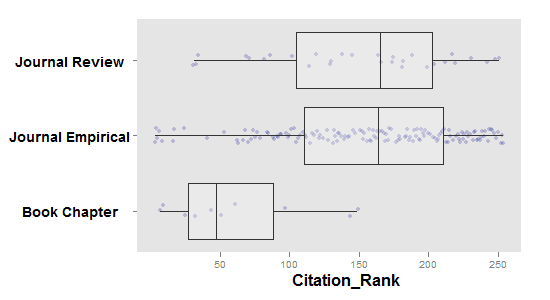
much, as well as any odd items such as book reviews. To make interpretation more intuitive, I inverted the rank order, so that
a high score meant lots of citations, and the boxplots showing the results are
in the Figure below.
Because I'm nerdy about these things, I did some stats, but
you don't really need them. The trend is very clear in the boxplot: book
chapters don't get cited. Well, you
might say, maybe this is because they aren't so good; after all, book chapters
aren't usually peer reviewed. It could be true, but I doubt it. My own
appraisal is that these chapters contain some of my best writing, because they
allowed me to think about broader theoretical issues and integrate ideas from
different perspectives in a way that is not so easy in an empirical article. Perhaps,
then, it's because these papers are theoretical
that they aren't cited. But no: look at the non-empirical pieces published
in journals. Their citation level is just as high as papers reporting empirical
data. Could publication year play a part? As mentioned above, I excluded papers
from the past five years; after doing
this, there was no overall correlation between citation level and publication
year.
Things may be different for other disciplines, especially in
humanities, where publication in books is much more common. But if you publish in
a field where most publications are in journals, then I suspect the trend I see
in my own work will apply to you too. Quite simply, if you write a chapter for an edited book, you might as
well write the paper and then bury it in a hole in the ground.
Accessibility is the problem. However
good your chapter is, if readers don't
have access to the book, they won't find it. In the past, there was at least a
faint hope that they may happen upon the book in a library, but these days,
most of us don't bother with any articles that we can't download from the
internet.
I'm curious as to whether publishers have any plans to tackle this issue. Are they still producing edited collections? I still get asked to contribute to these from time to time, but perhaps not so often as in the past. An obvious solution would be to put edited books online, just like journals, but there would need to be a radical rethink of access costs if so. Nobody is going to want to pay $30 to download a single chapter. Maybe publishers could make book chapters freely available one or two years after publication - I see no purpose in locking this material away from the public, and it seems unlikely this would damage book sales. If publishers don't want to be responsible for putting material online, they could simply return copyright to authors, who would be free to do so.
My own solution would be for editors of such collections to take matters into their own hands, bypass publishers altogether, and produce freely downloadable, web-based copy. But until that happens, my advice to any academic who is tempted to write a chapter for an edited collection is don't.
Reference
Eve Mardera, Helmut Kettenmann, & Sten Grillner (2010). Impacting our young Proceedings of the National Academy of Sciences, 107 DOI: 10.1073/pnas.1016516107
Subscribe to:
Posts (Atom)