Tuesday, August 19, 2014

Persistently High Methane Concentrations over Beaufort Sea

High methane concentrations have been showing up over Beaufort Sea over the past few days, as shown on the image below. This follows the recent high methane concentrations over the East Siberian Sea.


The persistent character of these very high methane concentrations over the Arctic Ocean indicates that methane has started to erupt from clathrates under the seabed, triggered by very warm water reaching the bottom of the Arctic Ocean.

Methane eruptions from hydrates in sediments under the Arctic Ocean helped mean methane levels reach new records, with mean global methane readings as high as 1835 parts per billion recorded at several altitudes on August 17, 2014.


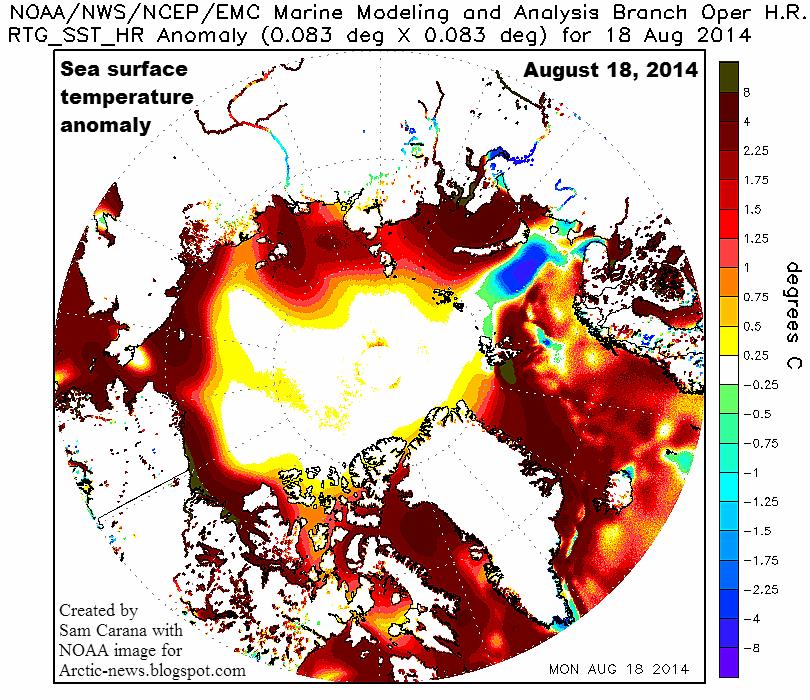
The very high sea surface temperature anomalies that show up on above image give an idea of the inflow of warm water from the Pacific Ocean through the Bering Strait. This is further highlighted by the combination image below.

[ click on image to enlarge ]
The situation is dire and calls for comprehensive and effective action, as discussed at the Climate Plan blog.


Friday, August 15, 2014

Heatwave to hit Greenland

A heatwave with temperature anomalies exceeding 36°F (20°C) is expected to hit Greenland between August 16 and 22, 2014, as illustrated by the image on the left and the animation on the right. 

Such heatwaves can be expected to hit the Arctic more frequently and with greater intensity, as temperatures in the Arctic are rising faster than elsewhere on Earth.

Such heatwaves can result in massive melting on Greenland, as persistent heat changes the texture of the snow and ice cover, in turn reducing its reflectivity. This makes that less sunlight is reflected back into space and is instead absorbed. 

The image below illustrates what a difference the presence of sea ice can make.
from: Arctic Warming due to Snow and Ice Demise
As the NSIDC/NOAA graphs below shows, melting on Greenland has been relatively modest this year when compared to the situation in 2012. By July 12, 2012, 97% of the ice sheet surface had thawed, according to this NASA analysis and this NOAA Arctic Report Card.


Melting on Greenland directly affects sea level rise, and melting on Greenland is accelerating due to a number of factors.

Projections of melting on Greenland have long been based on a warming atmosphere only, ignoring the warmer waters that lubricate glaciers and that warm Greenland's bedrock canyons that sit well below sea level.

Furthermore, there are growing quantities of black carbon deposits as a result of burning of fossil fuel and biomass. High temperatures have recently caused ferocious wildfires in Canada that have in turn caused a lot of black carbon to go up high into the atmosphere.

And of course, the atmosphere over the Arctic is warming up much faster than most models had projected. This in turn causes triggers further feebacks, including more extreme weather events such as heatwaves and rain storms that can be expected to hit Greenland with ever more frequency and ferocity. Further feedbacks include methane eruptions from the heights of Greenland, as discussed at the Arctic Feedbacks Page.

When also taking into account the accelerating impact of such factors on melting in Greenland, sea levels could rise much faster than anticipated, as illustrated by the image below.

from: more than 2.5m sea level rise by 2040? 

Note that sea level rise is only one of the many dangers of global warming, as discussed in the 2007 post Ten Dangers of Global Warming.

The image on the right shows a temperature forecast for August 16, 2014, with parts of Greenland changing in color from blue into green, i.e. above the melting point for snow and ice.

Such high temperatures are now hitting locations close to the North Pole ever more frequently, due to the many feedbacks that are accelerating warming in the Arctic, as discussed at this Feedbacks page.

One of the most dangerous feedbacks is a sudden eruption of huge quantities of methane from the seafloor of the Arctic Ocean, as discussed in a recent post.

The impact of such feedbacks can be accumulative and interactive, resulting in self-reinforcing feedbacks loops that can escalate into runaway warming.

Below is another forecast by ClimateReanalyzer for August 16, 2014, showing the remarkable ‘greening’ of Greenland, as well as the very high temperatures reaching the higher latitudes of North America.


Also see the very high sea surface temperatures around Greenland on the image below, created with ClimateReanalyzer.

Sea surface temperature anomalies on August 15, 2014. 
In conclusion, the situation is dire and calls for comprehensive and effective action, as discussed at the Climate Plan blog. 


Wednesday, August 13, 2014

Horrific Methane Eruptions in East Siberian Sea

A catastrophe of unimaginable propertions is unfolding in the Arctic Ocean. Huge quantities of methane are erupting from the seafloor of the East Siberian Sea and entering the atmosphere over the Arctic Ocean.


As the top image above shows, peak levels as high as 2363 ppb were recorded at an altitude of 19,820 ft (6041 m) on the morning of August 12, 2014. The middle image shows that huge quantities of methane continued to be present over the East Siberian Sea that afternoon, while the bottom image shows that methane levels as high as 2441 ppb were recorded a few days earlier, further indicating that the methane did indeed originate from the seafloor of the East Siberian Sea.

On August 12, 2014, peak methane levels at higher altitudes were even higher than the readings mentioned on above image. Levels as high as 2367 ppb were reached at an altitude of 36,850 ft (11,232 m). Such high levels have become possible as the huge quantities of methane that were released from the seafloor of the Arctic Ocean over the period from October 2013 to March 2014, have meanwhile descended to lower latitudes where they show up at higher altitudes.

Methane eruptions from the Arctic Ocean's seafloor helped push up mean global methane levels to readings as high as 1832 ppb on August 12, 2014.

Ironically, the methane started to erupt just as an international team of scientists from Sweden, Russia and the U.S. (SWERUS-C3), visiting the Arctic Ocean to measure methane, had ended their research.

Örjan Gustafsson describes part of their work: “Using the mid-water sonar, we mapped out an area of several kilometers where bubbles were filling the water column from depths of 200 to 500 m. During the preceding 48 h we have performed station work in two areas on the shallow shelf with depths of 60-70m where we discovered over 100 new methane seep sites.”

Örjan Gustafsson adds that “a tongue of relatively warm Atlantic water, with a core at depths of 200–600 m may have warmed up some in recent years. As this Atlantic water, the last remnants of the Gulf Stream, propagates eastward along the upper slope of the East Siberian margin, our SWERUS-C3 program is hypothesizing that this heating may lead to destabilization of upper portion of the slope methane hydrates.”

Schematics of key components of the Arctic climate-cryosphere-carbon system that are addressed by the SWE-C3 Program. a,b) Sonar images of gas plumes in the water column caused by sea floor venting of methane (a: slope west of Svalbard, Westbrook et al., 2009; b: ESAO, Shakhova et al., 2010, Science). c) Coastal erosion of organic-rich Yedoma permafrost, Muostoh Island, SE Laptev Sea. d) multibeam image showing pockmarks from gas venting off the East Siberian shelf. e) distribution of Yedoma permafrost in NE Siberia. f) Atmospheric venting of CH4, CO2. (SWERUS-C3)
Örjan Gustafsson further adds that SWERUS-C3 researchers have on earlier expeditions documented extensive venting of methane from the subsea system to the atmosphere over the East Siberian Arctic Shelf.

In 2010, team members Natalia Shakhova and Igor Semiletov estimated the accumulated methane potential for the Eastern Siberian Arctic Shelf alone to be as follows:
- organic carbon in permafrost of about 500 Gt;
- about 1000 Gt in hydrate deposits; and
- about 700 Gt in free gas beneath the gas hydrate stability zone.

Back in 2008, Shakhova et al. wrote a paper warning that “we consider release of up to 50 Gt of predicted amount of hydrate storage as highly possible for abrupt release at any time.”

Last year, a team of researchers including Professor Peter Wadhams calculated that such a 50 Gt release would cause global damage with a price-tag of $60 trillion.

As Prof Wadhams explains in the video below: “We really have no choice except to seriously consider the use of geoengineering.”


Sea surface temperatures as high as 18.8°C are now recorded at locations where warm water from the Pacific Ocean is threatening to invade the Arctic Ocean.

At the same time, huge amounts of very warm water are carried into the Arctic Ocean by the Gulf Stream through the North Atlantic. The image below illustrates how the Gulf Stream brings very warm water to the edge of the sea ice.

Waters close to Svalbard reached temperatures as high as 62°F (16.4°C) on July 29, 2014 (green circle). Note that the image below shows sea surface temperatures only. At greater depths (say about 300 m), the Gulf Stream is pushing even warmer water through the Greenland Sea than temperatures at the sea surface.

Since the passage west of Svalbard is rather shallow, a lot of this very warm water comes to the surface at that spot, resulting in an anomaly of 11.1°C. The high sea surface temperatures west of Svalbard thus show that the Gulf Stream can carry very warm water (warmer than 16°C) at greater depths and is pushing this underneath the sea ice north of Svalbard. Similarly, warm water from greater depth comes to the surface where the Gulf Stream pushes it against the west coast of Novaya Zemlya.


[ click on image to enlarge ]
As Malcolm Light writes in an earlier post: The West Spitzbergen Current dives under the Arctic ice pack west of Svalbard, continuing as the Yermak Branch (YB on map) into the Nansen Basin, while the Norwegian Current runs along the southern continental shelf of the Arctic Ocean, its hottest core zone at 300 metres depth destabilizing the methane hydrates en route to where the Eurasian Basin meets the Laptev Sea, a region of extreme methane hydrate destabilization and methane emissions.

The images below give an impression of the amount of heat transported into the Arctic Ocean.


The image below gives an idea how methane eruptions from the seafloor of the Arctic Ocean could unfold over the coming decades. For more on this image, see this post and this page.


As said, the situation is dire and calls for comprehensive and effective action, as discussed at the Climate Plan blog at climateplan.blogspot.com and as illustrated by the image below.


Friday, August 8, 2014

The Arctic Methane Monster's Rapid Rise


Researcher Jennifer Hynes recently gave a frightening presentation about the situation in the Arctic and the odds that things will rapidly spiral out of control soon, escalating into runaway global warming a few decades from now. 


Above, a slide from the presentation, warning about the danger of earthquakes causing methane hydrate destabilization (from: Smoke Blankets North America). As the map below shows, 77 M4+ earthquakes did hit locations around Greenland in the year 2014 up until August 4.


Below is Jennifer's presentation, also on youtube at youtube.com/watch?v=a9PshoYtoxo


The image below shows sea surface temperature anomalies in the Arctic at August 7, 2014.


Warm water is carried into the Arctic Ocean by the Gulf Stream, as illustrated by the image below.
[ click on image to enlarge ]
The image shows how the Gulf Stream brings warm water to the edge of the sea ice. Waters close to Svalbard reached temperatures as high as 15.6°C (60.1°F) on August 8, 2014 (green circle). Note that what the image shows are sea surface temperatures only. At greater depths (say 300 m), warm water is pushed through the Greenland Sea by the Gulf Stream. Since the passage west of Svalbard is rather shallow, a lot of this warm water comes to the surface there. The high sea surface temperatures west of Svalbard thus indicate that the Gulf Stream is carrying very warm water (warmer than 15°C) at greater depths and is pushing this underneath the sea ice north of Svalbard.

As said, the situation is dire and calls for comprehensive and effective action, as discussed at the Climate Plan blog at climateplan.blogspot.com and as illustrated by the image below.


Monday, August 4, 2014

Warm waters threaten to trigger huge methane eruptions from Arctic Ocean seafloor

The evidence of abrupt high methane releases in the Arctic Ocean is accumulating. The graph below shows in situ methane measurements taken at the Barrow Observatory, including recent levels as high as close to 2200 parts per billion (ppb).


Satellite data picture a similarly dire situation. Global mean methane levels as high as 1831 ppb were recorded on the morning of July 30, 2014, while peak methane levels as high as 2330 ppb were recorded that morning. More recently, peak methane levels as high as 2522 ppb were recorded (on August 2, 2014).

IPCC/NOAA figures suggest that methane levels were rising by some 5 to 6 ppb annually, reaching 1814 ppb in 2013. While methane levels at lower altitudes have indeed shown little rise, much larger rises have been recorded at higher altitudes, as illustrated by the image below.


These high methane levels recorded at higher altitudes appear to be caused by the huge quantities of methane released from the seafloor of the Arctic Ocean during the period from end 2013 to early 2014. This methane has meanwhile risen to higher altitudes, while also descending to lower latitudes, wreaking havoc on weather patterns around latitude 60° North.

The releases of methane from the seafloor of the Arctic Ocean were caused by water that had warmed up strongly off the east coast of North America from June 2013. It took some months for this warm water to be carried by the Gulf Stream into the Arctic Ocean.


Meanwhile, very high sea surface temperatures are recorded in the Arctic Ocean, as above image shows, while warm water is carried into the Arctic Ocean by the Gulf Stream, as illustrated by the image below.


As said, the situation is dire and calls for comprehensive and effective action, as discussed at the Climate Plan blog.


Tuesday, July 29, 2014

More than 2.5m Sea Level Rise by 2040?

A warming period more than 400,000 years ago pushed the Greenland ice sheet past its stability threshold (which may have been no more than several degrees above pre-industrial temperatures). This resulted in a nearly complete deglaciation of southern Greenland, raising global sea levels some 4.5-6 meters, found a recent study by Reyes et al. Due to melting elsewhere, global mean sea level then was 6 to 13 metres above the present level. Indeed, melting of the entire West Antarctic Ice Sheet can add a further 6-meter rise in sea levels. If the East Antarctic Ice Sheet (EAIS) were to melt as well, sea levels would rise by around 70 metres.

Sea level is now rising by 3.1mm (0.122 inch) per year. Much of this rise is due to rising temperatures, but there are also other factors. One quarter of the rise results from groundwater depletion, while run off from melting ice and glaciers adds another quarter and the remainder is attributed to thermal expansion of sea water. Furthermore, as temperatures rise, feedbacks start to kick in, e.g. the kinetic energy from stronger waves and more intense storms can speed things up.

Clearly, a rapid multi-meter rise would be devastating as it would flood many coastal cities, as well as much of the land now used to grow food. By how much have sea levels been rising recently and how fast can they be expected to rise in the near future?
NASA image, data by the JPL PODAAC, in support of the NASA's MEaSUREs program.
Sea levels have risen by some 60 mm over the past 20 years, as above NASA image shows, which has a linear trendline added. The question is whether a linear trendline is the most appropriate trendline, given that it suggests that a similar rise could be expected over the next 20 years. A polynomial trendline appears to fit the data better, as the animation below shows.


Such a polynomial trendline, however, points at a similar rise (of some 50 mm) in just four years time, with an even more steeper rise to follow, as illustrated by the image below.


And indeed, such a rise doesn't slow down there. A polynomial trendline applied to the data points at a sea level rise of more than 2.5 m (8.2 ft) by the year 2040.


The image below gives an idea of what a sea level rise of six feet (1.829 m) would do to the City of New York. Of course, this is only the sea level rise. Storm surge would come on top of this, as discussed at Ten Dangers of Global Warming.


So, what would be more appropriate, to expect sea levels to continue to rise in a linear way, or to take into account feedbacks that could speed things up? Where such feedbacks could lead to is illustrated by the image below.
[ from: How many deaths could result from failure to act on climate change? click on image to enlarge ]
This calls for comprehensive and effective action, as discussed at the Climate Plan blog.


References

- South Greenland ice-sheet collapse during Marine Isotope Stage 11, Reyes et al. (2014)
http://www.nature.com/nature/journal/v510/n7506/full/nature13456.html

- Nonsustainable groundwater sustaining irrigation: A global assessment, Yoshihide Wada et al. (2012)
http://onlinelibrary.wiley.com/doi/10.1029/2011WR010562/abstract

- Groundwater Depletion Linked to Rising Sea Levels
http://www.waterworld.com/articles/2010/11/groundwater-depletion-linked-to-rising.html

- Assessment of the Jason-2 Extension to the TOPEX/Poseidon, Jason-1 Sea-Surface Height Time Series for Global Mean Sea Level Monitoring, Beckley et al. (2010)
http://www.tandfonline.com/doi/abs/10.1080/01490419.2010.491029

- Feedbacks in the Arctic
http://climateplan.blogspot.com/p/feedbacks.html

- How many deaths could result from failure to act on climate change? (2014)
http://arctic-news.blogspot.com/2014/05/how-many-deaths-could-result-from-failure-to-act-on-climate-change.html


Monday, July 28, 2014

A film review from 32,000 feet: Noah


I don't do long haul flights much. They wreck my frontal lobe function and leave me not only with a headache, but with a sense of befuddlement that can take a few days to abate. I also find that if I try to while away the time with work, or read a book, it just makes matters worse, so I am reduced to watching the films. And now at 32,000 feet en rpute to New York, I can think of nothing better to pass the time than to write a review of the film I have just seen, Noah.


I grew up enjoying epics such as the Ten Commandments (with memorable plague of frogs and parting of Red Sea), Samson and Delilah (where, according to one review "Victor Mature fits neatly into the role of the handsome but dumb hulk of muscle")  and the Last Days of Sodom and Gomorrah (this trailer tells you all you need to know). I expected something similar – an attempt at telling a Biblical story through film, but with use of CGI to create better special effects.  But this was more like a bizarre mix of Lord of the Rings, Harry Potter and Pirates of the Caribbean, with a touch of Eastenders thrown in. Although I jotted down occasional notes as I viewed it, this is my reconstruction from memory and so accuracy is not guaranteed, especially given the befuddled state in which I watched.


So at the start we have Noah's father wandering around a barren landscape with his son. We know he is a goodie because a wounded beast comes scampering into view, and although it is of ferocious appearance, Noah's dad approaches it and speaks gently to it and attempts to deal with its wounds. However, a band of evil men then appear. We know they are evil because they have shot the animal and explain that they intend to eat it, on the grounds that 'The Creator' (the word 'God' is never used, interestingly) has not provided adequately for them, and so they need to eat meat. Noah's dad disapproves and so they bump him off, while Noah looks on in horror. Flash forward, then to the next generation, where Noah and his wife and children are wandering the same dismal landscape. It's not clear what they live on, since they disapprove of eating animals, and there's no vegetation to be seen. They also have quite respectable, if drab, clothes, and one wonders how these were achieved, if animal skins are verboten.


However, one really does not need to worry too much about plausibility because it becomes clear that supernatural forces are at play. Noah communicates with the Creator through dreams in which he is under water surrounded by drowning creatures. He decides to consult his grandad, Methusalah (Anthony Hopkins as a cross between Sauron, Obi Wan Kenobe and a hobo), who lives alone in a quarry, apparently not doing much but just waiting to be consulted.


On the way there (or possibly the way back) the family find a place littered with bodies, from which they rescue a small girl who is wounded. Marauding hordes, very reminiscent of Orcs or whatever the marauding things in Lord of the Rings are, attack them and they seem doomed, but escape into an area that everyone fears to enter. This is because it is controlled by a group of giant monsters who look like cookie monsters  that have spent too long in the microwave. These quell the marauding hordes, but spare Noah and his family. Here the plot goes a bit awry. The cookie monsters are 'the Watchers' and seem to be angels who were cast out of Heaven at the time of the Fall. If I got it right (the drinks trolley turned up around this time and I was a bit distracted) they were cast out because they wanted to protect humanity, incurring the wrath of the Creator who was utterly disaffected with humanity after Eve chomped at the forbidden fruit. Nevertheless, they approve of Noah because he wants to do the bidding of the Creator. Slight logical disconnect there, I think, but hey, they're only cookie monsters.


Fast forward a few more years, and Emma Watson pops up. This was very confusing, because her behaviour and reactions were exactly as in the Harry Potter movies, in that she spent a lot of time chasing after the boys trying to get them to behave sensibly. One of them, Shem, looks like the one in Pirates of the Caribbean who isn't Jack Sparrow (rather a shame that Jack Sparrow himself didn't feature, especially once the ark got waterborne, when he could have come in handy). He fancies Hermione, which is hardly surprising, as she is the only female around apart from his mother. However, there is a problem. Hermione is barren because of the injuries she suffered as a child. Everyone seems to know this as a given fact, though one might have thought that a bit of tentative exploratory sex would have been worth a try. Brother number two, who, perhaps as a joke in this vegetarian family, is named Ham, is jealous that he hasn't got a woman.


Somewhere along the way Noah has another consultation with Methuselah and decides that the earth is going to be destroyed by the Creator because of man's wickedness, and that what is needed is an ark. He doesn't have much of a clue about design, because what he ends up with is a giant wooden portakabin which doesn't seem to have a hull. This could be a consequence of enlisting the help of the cookie monsters, whose intellectual powers seem quite limited. But the birds are impressed, and start flocking in. The previous evening I'd watched a documentary about penguins, and so the thought uppermost in my mind was that the ark would have had a massive problem with poo – certainly even a pair of penguins would be capable of creating a substantial problem if the documentary was to be believed. However, here the script-writer had a moment of genius – Noah's wife fumigated the ark with a substance that sent all animals to sleep – except humans.


Somewhere about this point, Russell Crowe confused us all acquiring a number one clipper and trimming his hair and beard. I initially thought he was a new villain, and only recognised him when he put his hoodie back on. Ham also seemed to have access to the clipper and remained clean shaven with a short haircut throughout, whereas Shem had flowing locks and a beard, albeit a tidy one. The state of the men's grooming was a dead giveaway to their ethical status in the film, as became apparent when, in a genius piece of casting, Ray Winstone suddenly cropped up as Cain, with very unkempt hair and beard, a band of evil followers, and a cockney accent.  For reasons hard to fathom, Cain wanted to enlist Ham, but Noah wasn't having any of that, so Cain settled for establishing a camp near to the ark. This was rather spectacularly filmed to resemble a scene of hell by Hieronymous Bosch, but without the giant ears, with was much screeching and wailing, indicative of the sorry state of social mores. Cain did however groom his beard into two birfurcated points, perhaps suggesting some attempt to reform.


Noah's wife realises that the ark plan has a fatal flaw, which is a shortage of fertile women. Off she goes to consult Methuselah, who emerges from his quarry to track down Hermione, and perform an instant gynaecological miracle with his magic touch. This is followed almost immediately by her indulging in wild passionate sex with Shem (hinted at, as this is a film suitable for children). Ham, meanwhile, has gone into Cain's encampment to find a woman.  However, no sooner has he done so when Cain instigates an uprising to attack and take over the ark, and in the course of this, Ham's woman is killed. Somehow, Cain has invented a form of bazooka gun, which proves effective against the cookie monsters, who die in a spectacular blaze of fireworks before ascending to heaven, apparently now forgiven by the Creator.


I was rather disappointed by the rain. I had expected lots of it, but what was shown seemed rather pathetic when compared to the floods in the UK earlier this year. Instead, though, we had great geysers of water shooting up out of the ground – a bit like a supercharged version of the fountains at Heathrow's terminal  5 – plus the odd tsunami.  In any case, the Creator achieved his aim of drowning everyone except those on the ark, which remarkably, floated upright despite its unpromising design. Unbeknown to Noah, however, Cain had managed to stow away on the ark, where he proceeded to demonstrate how utterly evil he was by eating the odd animal. He enlisted the help of Ham, who was especially cross with Noah for failing to rescue the woman he had found in a ditch.


Meanwhile, Noah was becoming increasingly deranged. He had decided that the whole point of the exercise was to save the animals but rid the world of man, because man would only despoil the planet again if allowed to live. It was therefore imperative that no new humans should be born. This was problematic because Hermione was pregnant. Now, if your father had just told you that he was enacting God's will to exterminate the human race, and you found that your wife was pregnant, what would you do? Well, Shem thought it a good idea to go and ask for his blessing. Bad move. Noah isn't having any of it: "If you bear a girl, in the moment of her birth I will cut her down" (Yup, this is verbatim dialogue). In fact, Hermione, as one might have anticipated, outperforms and delivers twin girls. Shem has decided to kill Noah to save his babies, around the same time that Cain has decided to kill him, saying "Your ark, your beasts and your women are all mine. I will build a new world in my image." Cain has also enlisted Ham as backup assassin. You would have thought that with these odds, Noah's fate would be sealed, but somehow in a confusing fight scene in which everyone dived in, Cain ended up dead and Noah very much alive and still hell-bent on killing the twins. But, guess what, when it came to it, he was unable to carry out the act. And at that point a dove landed on the ark with a twig in its beak, and everyone cheered up.


That was about it. They landed somewhere that looked like Scotland and settled down, and after a brief period of depression and drunkenness, Noah re-established good relations with his family, except for Ham, who wandered off into the wilderness, perhaps hoping to find a female survivor of the flood.


The weirdest part of all this was that although I found the whole thing hilarious, I felt offended by the film on behalf of religious people. It is a little known fact about me that in my teenage years I was a Sunday School teacher - and so I have an extensive if rusty knowledge of the Bible.  I found myself getting especially cross about the cookie monsters, thinking that it was a travesty of the Bible story to introduce all this supernatural stuff. And then I realised what a ridiculous thought that was.