Showing posts with label accelerated. Show all posts

Thursday, June 25, 2015

Accelerated Warming in the Arctic


Warming in the Arctic is accelerating. On June 25, 2015, high temperatures hit North America. Temperatures as high as 30.3°C (86.54°F) were recorded where the Mackenzie River is flowing into the Arctic Ocean.

June 25, 2015 - High temperatures over North America, close to the Arctic Ocean

On July 1, 2015, temperatures are forecast to be as high as 111.4°F (or 44.1°C) near Chico, north of San Francisco. Temperatures are forecast to be high over most of North America and Eastern Siberia, threatening to further warm up waters of the Arctic Ocean.

Forecast for July 1, 2015 - High temperatures over North America, close to the Arctic Ocean

The image below shows that on June 27, 2015, temperatures of well over 40°C (104°F) were recorded in Europe and in Pakistan, where temperatures earlier this month had reached 49°C (120.2°F) in some places. The heat wave reportedly killed 1233 people in Karachi alone. This in addition to the 2500 people killed earlier in India by high temperatures.

June 27, 2015 - High temperatures over Russia, close to the Arctic Ocean
High temperatures at such locations are very worrying, for a number of reasons, including:
  • They are examples of heatwaves that can increasingly extend far to the north, all the way into the Arctic Ocean, speeding up warming of the Arctic Ocean seabed and threatening to unleash huge methane eruptions. 
  • They set the scene for wildfires that emit not only greenhouse gases such as carbon dioxide and methane, but also pollutants such as carbon monoxide (that depletes hydroxyl that could otherwise break down methane) and black carbon (that when settling on ice causes it to absorb more sunlight).
  • They cause warming of the water of rivers that end up in the Arctic Ocean, thus resulting in additional sea ice decline and warming of the Arctic Ocean seabed. 
June 24, 2015 - Smoke from wildfires in Alaska - from: wunderground.com
The image below shows increased sea surface temperature anomalies in the Arctic. Note the warming in the area of the Beaufort Sea where the Mackenzie River is flowing into the Arctic Ocean.


Very warm water is also flowing from the Pacific Ocean through the Bering Strait into the Arctic Ocean.  As the image below shows, the water that is flowing into the Arctic Ocean from the Pacific is much warmer than it used to be, as much as 6.1°C (10.98°F) warmer.

View the flow of the water on the animated version of above image at earth.nullschool.net
As said above, warm water flowing from rivers into the Arctic Ocean is a major contributor to these sea surface temperature anomalies. As also illustrated by the NOAA image below, rivers carrying warm water into the Bering Strait include the Kobuk River, the Naotak River and the Yukon River that flows all the way from British Columbia, Canada, through Alaska and ends in the Bering Strait. Sea surface temperatures near the coast of Alaska were as high as 19°C (66.2°F) from June 21-24, 2015.

Sea surface temperatures near the coast of Alaska as high as 19°C (66.2°F) from June 21-24, 2015
The Naval Research Laboratory animation below shows changes to Arctic sea ice thickness. Sea ice thickness (in m) down to zero where the Mackenzie River flows into the Arctic Ocean and in the Bering Strait where warm water from the Pacific is entering the Arctic Ocean.


The situation is dire and calls for comprehensive and effective action, as discussed at the Climate Plan.


Related

- Gulf Stream brings ever warmer water into Arctic Ocean
http://arctic-news.blogspot.com/2015/06/gulf-stream-brings-ever-warmer-water-into-arctic-ocean.html

- High Temperatures in the Arctic

- Heat Wave Forecast For Russia Early June 2015http://arctic-news.blogspot.com/2015/06/heat-wave-forecast-for-russia-early-june-2015.html

Sea surface temperature anomalies in the Arctic. Note the warming in the area of the Beaufort Sea where the Mackenzie...
Posted by Sam Carana on Thursday, June 25, 2015

Wednesday, April 16, 2014

Near-Term Human Extinction

Global Warming and Feedbacks

Is there a mechanism that could make humanity go extinct in the not-too-distant future, i.e. within a handful of decades?

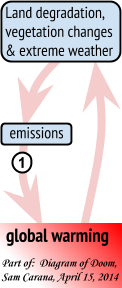
Most people will be aware that emissions due to human activity are causing global warming, as illustrated by the arrow marked 1 in the image on the left. Global warming can cause changes to the land, to vegetation and to the weather. This can result in wildfires that can in turn cause emissions, thus closing the loop and forming a self-reinforcing cycle that progressively makes things worse.

Furthermore, less forests and soil carbon also constitute a decrease in carbon sinks, resulting in carbon that would otherwise have been absorbed by such sinks to instead remain in the atmosphere, thus causing more global warming, as illustrated by the additional downward arrow in the image on the right. In conclusion, there are a number of processes at work that can all reinforce the impact of global warming.

Emissions can also contribute more directly to land degradation, to changes in vegetation and to more extreme weather, as indicated by the additional arrow pointing upward in the image on the right. A recent study by Yuan Wang et al. found that aerosols formed by human activities from fast-growing Asian economies can cause more extreme weather, making storms along the Pacific storm track deeper, stronger, and more intense, while increasing precipitation and poleward heat transport.

Accelerated Warming in the Arctic

Similar developments appear to be taking place over the North Atlantic. Huge pollution clouds from North America are moving over the North Atlantic as the Earth spins. In addition, the Gulf Stream carries ever warmer water into the Arctic Ocean. As the image below shows, sea surface temperature anomalies at the highest end of the scale (8 degrees Celsius) are visible off the coast of North America, streching out all the way into the Arctic Ocean.


As said, feedbacks as are making the situation progressively worse. Feedback loops are causing warming in the Arctic to accelerate. Warming in the Arctic is accelerating with the demise of the snow and ice cover in the Arctic, and this is only feedback #1 out out many feedbacks that are hitting the Arctic, as described in an earlier post. As the temperature difference between the equator and the Arctic decreases, the Jet Stream is changing, making it easier for cold air to move out of the Arctic and for warm air from lower latitudes to move in (feedback #10).


Abrupt Climate Change leading to Extinction at Massive Scale

The danger is that, as temperatures over the Arctic Ocean warm up further and as the Gulf Stream carries ever warmer water into the Arctic Ocean, large quantitities of methane will erupt abruptly from the seafloor of the Arctic Ocean, adding a third kind of warming, runaway warming resulting in abrupt climate change, and leading to mass death, destruction and extiction of species including humans.

Persistence of such a progression makes it inevitable that the rest of Earth will follow the huge temperature rises in the Arctic. Massive wildfires will first ignite across higher latitudes, adding further greenhouse gas emissions and causing large deposits of soot on the remaining snow and ice on Earth, with a huge veil of methane eventually spreading around the globe. The poster below, from an earlier post, illustrates the danger.

[ click on image to enlarge - note that this is a 1.8 MB file that may take some time to fully load ]
Views by Contributors

How likely is it that the above mechanism will cause human extinction within the next few decades? What views do the various contributors to the Arctic-news blog have on this?

Guy McPherson has long argued that, given the strengths of the combined feedbacks and given the lack of political will to take action, near-term human extinction is virtually inevitable.

In the video below, Paul Beckwith responds to the question: Can climate change cause human extinction?


Further contributors are invited to have their views added to this post as well. While many contributors may largely share Paul Beckwith's comments, it's important to highlight that contributors each have their own views, and this extends to their preference for a specific plan of action.

Geo-engineering

One of the more controversial issues is the use of geo-engineering. Guy McPherson doesn't believe geo-engineering will be successful. In the video below, Paul Beckwith gives his (more positive) views on this.


I must admit that the lack of political will to act is rather depressing, especially given the huge challenges ahead. So, I can understand that this can make some of us pessimistic at times. Nonetheless, I am an optimist at heart and I am convinced that we can get it right by giving more support to a Climate Plan that is both comprehensive and effective, as discussed at ClimatePlan.blogspot.com


Tuesday, August 13, 2013

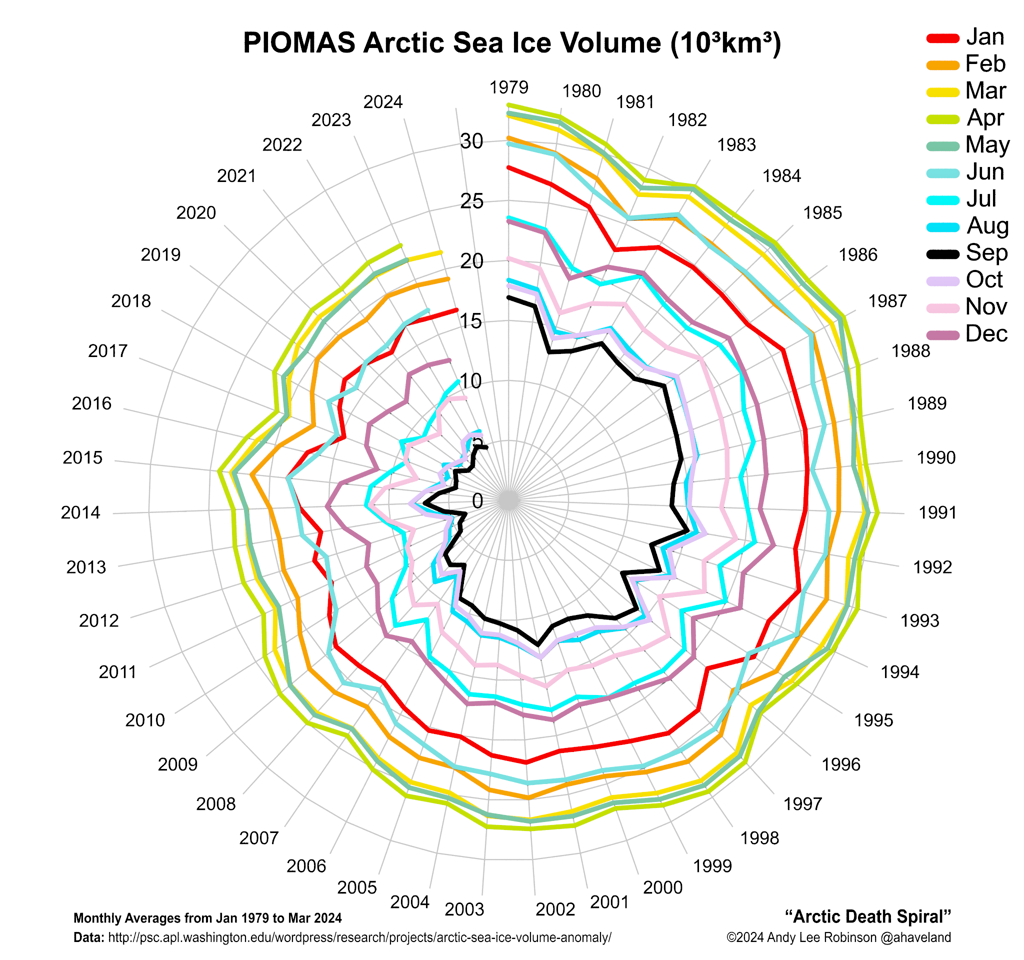
Arctic Death Spiral - Evolution to July 2013

Image by Andy Lee Robinson, from http://haveland.com/share/arctic-death-spiral.png
The video below is a visualization of the Arctic Death Spiral showing the evolution of the volume of sea-ice over time from 1979 to July 2013.

The rate of ice loss in the Arctic is staggering. Since 1979, the volume of Summer Arctic sea ice has declined by more than 80% and is accelerating faster than scientists believed it would, or even could melt.


Pitch of the notes are proportional to the average sea-ice volume for each month. Spectral filters are derived from the average sea-ice volume for each year. Produced using Perl and PovRay, Midi perl and Reason and Virtualdub on a cluster of Linux servers.


Above image is another way to visualize the data. It is a screenshot from the video below, by Andy Lee Robinson, illustrating the dramatic decline since 1979 until July 2013.

Andy Lee Robinson
The soundtrack "Arctic Requiem" also by Andy Lee Robinson, is available for free download: http://haveland.com/share/Arctic-Requiem.mp3

Sea Ice Volume is calculated using the Pan-Arctic Ice Ocean Modeling and Assimilation System (PIOMAS, Zhang and Rothrock, 2003) developed at APL/PSC.

Source data is available from:
http://psc.apl.washington.edu/wordpress/research/projects/arctic-sea-ice-volume-anomaly/