Showing posts with label Andrew Glikson. Show all posts

Saturday, September 6, 2014

Antarctica linked to Arctic

Waters in the Arctic Ocean continue to warm up. Very warm waters from the North Atlantic and Pacific Ocean are invading the Arctic Ocean.


Waters in the North Atlantic and in the North Pacific are very warm, due to a number of reasons.

What is happening in the oceans is very important in this respect. As discussed in earlier posts, most of the extra heat caused by people's emissions goes into the oceans.

The great ocean conveyor belt (Thermohaline Circulation), brings warm water from the southern hemisphere to the northern hemisphere.

The Gulf Stream is the North Atlantic leg of the great ocean conveyor belt, and it brings dense, salty water from the North Atlantic into the Arctic Ocean.

Saltier water is denser than fresher water because the dissolved salts fill interstices between water molecules, resulting in more mass per unit volume.

Very dense ocean water can be found in the North Atlantic because the North Atlantic has high salinity, due to high evaporation rates, while salty water is also coming from the Mediterranean Sea.

As also discussed in an earlier post, this dense, saltier water sinks in the North Atlantic, accumulating in deeper water.

By contrast, much of the Arctic Ocean has low salinity, due to ice melt and river runoff.  As it enters the Arctic Ocean, the warm and dense water from the Atlantic thus dives under the under the sea ice and under the less salty surface water in the Arctic Ocean.

In conclusion, much of the heat resulting from people's emissions accumulates in the North Atlantic and also ends up in the Arctic. This partly explains why surface temperatures are rising much faster at the poles, as illustrated by the NOAA image below.


There are further reasons why surface air temperatures elsewhere (other than at the poles) are rising less rapidly than they did, say, a decade ago. As also discussed by Andrew Glikson in the post No Planet B, the increased amounts of sulphur emitted by the growing number of coal-fired power plants and by the burning of bunker fuel on sea is (temporarily) masking the full wrath of global warming.

Another reason is the growth of the sea ice around Antarctica, as illustrated by the CryosphereToday image on the left.

Melting takes place both in the Arctic and on Antarctica, but more so in the Arctic. Recent research of CryoSat-2 data reveals that Greenland alone is now losing about 375 cubic kilometers of ice annually, while in Antarctica the annual volume loss now is about 125 cubic kilometers.

Currents also distribute ocean heat in ways that make the Arctic warm up more than twice as rapidly as the Antarctic. In a recent paper, John Marshall et al. further suggest that ozone depletion also contributes to this.

All this makes that, while the jet streams on the northern hemisphere are circumnavigating the globe at a slower pace, jet streams on the southern hemisphere are getting stronger, making it more difficult for warm air to enter the atmosphere over Antarctica, while the stronger winds also speed up sea currents on the southern hemisphere. This makes the sea ice around Antarctica grow, and as the sea ice spreads further away from Antarctica, temperatures of surface waters around Antarctica are falling.

Growth of the sea ice around Antarctica makes that more sunlight is reflected back into space. There now is some 1.5 million square kilometers more sea ice around Antarctica than there used to be. The albedo change associated with sea ice growth on the southern hemisphere can be estimated at 1.7 W/sq m, i.e. more than the total RF of all CO2 emission caused by people from 1750 to 2011 (IPCC AR5).


The rapid growth of sea ice on the southern hemisphere alone goes a long way to explain why, over the past three months, surface air temperatures have not been much higher than they used to be, both globally and in the Arctic, as illustrated by above NOAA image. What has also contributed to warmer temperatures around latitude 60 on the northern hemisphere is the fact that methane has accumulated in the atmosphere at that latitude, as discussed in earlier posts.

Arctic SST far exceed anything ever seen in human history
So, does the sea ice on the southern hemisphere constitute a negative feedback that could hold back global warming? It doesn't.

It may temporarily keep surface temperatures close to what they used to be, as the sea ice reflects lots of sunlight back into space, but at the same time ocean temperatures are rising strongly, as the sea ice also prevents heat from radiating out of the waters around Antarctica.

The latter also helps explaining the colder surface temperatures over those waters.

Much of this additional ocean heat has meanwhile been transported by the great ocean conveyor belt to the northern hemisphere.

No time before in human history has such a huge amount of ocean heat accumulated in the North Atlantic and the North Pacific. This heat is now threatening to invade the Arctic Ocean and trigger huge temperature rises due to methane eruptions from the seafloor.


The situation is dire and calls for comprehensive and effective action, as dicussed at the Climate Plan blog.

Wednesday, September 4, 2013

Existential risks to our planetary life-support systems

By Andrew Glikson

Figure 1. The future of Earth’s living environment is a non-issue in the current
Australian election - NASA image: Earth rising over the Moon
“We’re simply talking about the very life support system of this planet.”– Hans Joachim Schellnhuber, chief climate advisor to the German Government
It is not news that we are over stretching our planetary support systems: we have known for some time. In a 2009 keynote paper in Nature titled “A safe operating space for humanity”, a group of 26 prominent scientists showed three of nine interlinked planetary boundaries – boundaries we must stay within to keep Earth safe – have already been overstepped (see figure 2. below).

Those boundaries include:
  • climate change
  • biodiversity loss
  • the biogeochemical cycles.

Kevin Trenberth, chief scientist of the National Center for Atmospheric Research in Boulder, Colorado, states:
“Some of the human-induced changes are occurring 100-times faster than they occur in nature … And this is one of the things that worries me more than climate change itself. It’s actually the rate of change that’s most worrying … Ecosystems are not prepared for this jolt … And neither are many human endeavours, built around assumptions about how hot it’s going to be, how much it’s going to rain on our croplands, and how high the seas will rise.”

Figure 2. Planetary boundaries - the colored star-like area represents the estimated current state and the corners of the red octagon circumscribed by the Earth are the estimated boundaries. Systems whose safe operating space could not yet be determined were left out. Image from: Wikipedia / A safe operating space for humanity, Rockström et al, 2009.

This observation is dramatically demonstrated by the current rise of atmospheric greenhouse gases: this is at an unprecedented rate of 2 to 3 parts per million per year (see figure 3. below). This renders our era – the Anthropocene – a major oxidation event.

Such a growth rate of atmospheric greenhouse gases is extremely rare in geological history. The only analogue is the excavation of billions of tons of carbon from carbonate and shale formation hit by asteroids, such as the K-T impact 65 million years ago and massive global volcanic eruptions.

The consequences for the biosphere – the sixth mass extinction of species – threatens to become a tragedy for human ideals and for nature.

What or who is responsible for the unfolding calamity?

As defined, the Anthropocene is a new geological era triggered by a species which has uniquely mastered ignition. We are using it to excavate and release hundreds of billions of tons of carbon accumulated in Earth’s crust over geological eras into atmosphere.

Once a species masters sources of energy larger by orders of magnitude than its own physiological process (for Homo Sapiens this has been fire, electricity and nuclear fission), the species can hardly be expected to have the wisdom and degree of responsibility to stop its inventions from getting out of control.

Figure 3. Estimates of fossil fuel resources and equivalent atmospheric CO2 levels, including (1) emissions to date;
(2) estimated reserves, and (3) recoverable resources (1 ppm CO2 ~ 2.12 GtC). 
Hansen, 2012, figure 1; http://www.columbia.edu/~jeh1/mailings/2012/20120127_CowardsPart1.pdf
Unique among all species, humans adopted fire and combustion as their source of energy and power over nature. Over the last two million years, camped around fires, watching the flames, human imagination has grown to inquire, perceive future possibilities, develop fears, the craving for immortality, and the concept of gods. Fire has imparted a mythological quality to the human mind.

Once a stable climate was established in the Holocene (about 10,000 years ago), allowing cultivation and production of surplus food, this craving for omnipotence and omniscience was expressed by the building of monuments to immortality, the pyramids, as well as endless wars acquiring loot for this purpose.

Spiritual pantheism by pre-historic people such as the Australian Aboriginals has been transformed into admiration of sky gods and monotheism, then into crass materialism and the space cult.

But space exploration has taught us no other planet exists in the solar system on which the conditions exist for advanced life of the type hosted by Earth.

Since the greenhouse effect and its underlying laws of physics and chemistry were decoded in the 19th century, the question has arisen: to what extent will societies and their leaders accept the implications of the science for human industry and human future? Will the scientific method itself and the enlightenment form the basis of future decisions?

In 21st century Australia, the answer has been a resounding “no”.

Government and corporate decisions on climate change are being influenced by misrepresentations of the evidence. What began some 20 years ago as demonstration of solid empirical evidence has deteriorated to media-controlled debate replete with misunderstandings of the basic laws of physics, paleo-climate science, climate science, biological and ecological principles.

Figure 4. Relations between CO2 rise rates and mean global temperature rise rates during warming periods,
including the Paleocene-Eocene Thermal Maximum, Oligocene, Miocene, late Pliocene, Eemian (glacial termination),
Dansgaard-Oeschger cycles, Medieval Warming Period, 1750-2012 and 1975-2012 periods.
A multitude of media outlets and hundreds of websites proliferate notions ignorant of peer-reviewed science. The lesson of numerous attempted debates with those who deny the reality of global warming, or attempt to attribute it to natural non-human factors, is that those entertaining these notions cannot be dissuaded by any amount of scientific evidence.

Climate change misconceptions include claims that:
  • temperature rise came before CO2 rise during the glacial terminations and that therefore the current rise of temperature is not the result of CO2 rise. However, the effects of CO2and temperature variations are intertwined. During the last ~400,000 years glacial eras were terminated by periods of intense solar activity, affecting decreased CO2 solubility in warming water and thereby a rise in CO2 levels of the atmosphere. By contrast climate developments since the 18th century, when there was negligible or no rise in solar energy hitting the earth, were triggered by the anthropogenic greenhouse effect of the release of 560 billion tonnes of carbon, consistent with the basic laws of physics.
  • global warming is a recovery from the Little Ice Age. However, the Little Ice Age was caused when sunspot activity nearly ceased between 1650 and 1700, depressing global temperatures by 0.2-0.3C relative to preceding periods. By contrast, global warming from about 1975 has tracked toward more than 1.5C over the continents relative to pre-industrial temperatures.
  • cosmic rays flux affects warming. However, a dominant solar effect on the climate since 1970 is ruled out by measurements of solar radiation. The incidence of cosmic rays, which oscillate reciprocally with the 11 years sunspot cycle, has been shown to have minor effects on cloud nucleation and has not varied significantly since the mid-20th century.
  • carbon dioxide is emitted mainly from volcanoes. However, according to the United States Geological Survey (2012), sub-aerial and sub-marine volcanism emits approximately 150–260 million tons of CO2 a year. Anthropogenic emissions total about 35 billion tons CO2 a year.
Meanwhile, the unthinkable consequences of 4 degrees Celsius and higher temperature rise on the terrestrial atmosphere-ocean system have already begun. We are seeing a series of extreme weather events, reflecting the rise in energy/temperature of the atmosphere-ocean system – the “new normal”.

Andrew Glikson
Does responsibility lie with vested interests and fossil fuel lobbies promoting carbon saturation of the atmosphere? Does it lie with media barons and their mouthpieces hijacking the information systems of democracies, or with cowardly political “leaders” – presiding over extensive demise of future generations? Or does responsibility lie with all of us, with the species?

Deceived by pseudoscientific misconceptions, Homo “sapiens” continues to march toward a cliff, taking much of nature with it.

Earlier published at The Conversation.

Thursday, August 8, 2013

Climate, the “new normal” and the Australian elections

by Andrew Glikson

“The 1st Law of Humanity: Don’t kill your children!”
(Hans Joachim Schellnhuber, chief climate advisor to the German Government).
http://www.pik-potsdam.de/news/inshort/files/Schellnhuber-keynote-COP18-state-dinner-Doha.pdf

“Earth is worth £3,000 trillion, according to scientist's new planet valuing formula”
http://www.dailymail.co.uk/sciencetech/article-1361145/Earth-worth-3-000-trillionaccording-scientists-new-planet-valuing-formula.html

Earth rising over the Moon - http://www.nasa.gov/vision/earth/features/bm_gallery_4.html

That people can be duped to accept the destruction of the atmosphere – the lungs of the biosphere - is something no science-fiction has yet described, yet, as the summary of the scientific evidence presented below indicates, is now science-fact.

By the end of the 20th century powerful vested interests, including corporations and few billionaires and their political mouthpieces, combined to promote saturation of the terrestrial atmosphere with carbon dioxide, in contravention of climate science, are experiencing a Pyrrhic victory oblivious to the unfolding tragedy.

Nothing exemplifies these developments more than the current Australian elections. An internet search for the terms ‘Australia’ ‘elections’ and ‘climate change’ recovers very little in terms of party policies
(http://theconversation.com/why-labor-should-fight-the-2013-election-on-climate-change-13865, http://www.theguardian.com/environment/southerncrossroads/2013/aug/05/australian-election-2013-climate-change).

For example, the words ‘climate change’ (or ‘global warming’) were not even mentioned in a recent ABC prime time QandA pre-election program, in which the opposition shadow environmental minister participated. A cosmetic carbon price is threatened by the largest party, nor do many refer to Australia being on track to become an equivalent of Saudi Arabia in terms of global fossil fuel (coal) exports.

Featuring heavily in the current election campaign are the potential financial debts of future generations but little is said about the environmental debt – life under 4 degrees Celsius (above pre-industrial temperatures). Only a minor party is focused on the climate calamity.

When the theory of ‘economic rationalism’ emerged, pricing every item including cultural and spiritual values, a question arose as to “The price of the Earth”, currently estimated as 3000 trillion pounds (http://www.dailymail.co.uk/sciencetech/article-1361145/Earth-worth-3-000-trillion-according-scientists-new-planet-valuing-formula.html).

A Faustian Bargain is on (http://www.huffingtonpost.com/dr-james-hansen/doubling-down-on-our-faustian-bargain_b_2989535.html). What commenced some 20 years ago as a scientific debate has deteriorated to media-dominated pseudo-debate replete with misrepresentations of the science. Below I highlight the principal line of evidence emerging from geological and paleoclimate science:

Critical to the evolution of life since at least ~3.5 billion years-ago, from where the earliest known stromatolites and micro-fossils are recorded [1], are the combined effects of solar insolation and atmospheric chemistry, which control temperatures (-90° to +58°C) and the state of H2O at the surface as vapor, ice or liquid – the latter allowing life. Compensating for the continuous release of CO2 from the crust and mantle by volcanic eruption are tectonic, weathering and sedimentary processes that recycle the crust and lock CO2 in carbonates and organic matter subducted into the mantle [2], preventing a run-away build-up of atmospheric greenhouse gases (the Venus syndrome [3]).

Movement of carbon between land, atmosphere, and oceans in billions of tons of carbon per year. Yellow numbers are natural fluxes, red are human contributions in billions of tons of carbon per year. White numbers indicate stored carbon.
http://en.wikipedia.org/wiki/Carbon_cycle
The histories of the atmosphere, the oceans and life are thus closely intertwined. The atmosphere, mediating the carbon, oxygen and nitrogen cycles (see above image), acting as the lungs of  the biosphere, regulates an aqueous medium where microbiological metabolic processes occur, from chemo-bacteria around volcanic fumaroles, to nanobes in deep crustal fractures, to nearsurface phototrophs. From ~420 million years ago the advent of land plants ensued in flammable carbon-rich land surfaces interfaced with an oxygen rich atmosphere, ensuing in a combustible combination [4]. Repeatedly through geological history volcanic eruptions and asteroid impacts triggered major release of greenhouse gases (GHG) from the crust as well as extensive surface fires, major climate changes and mass extinctions of species [5].

Relations between CO2 rise rates and mean global temperature rise rates during warming periods, including
the Paleocene-Eocene Thermal Maximum, Oligocene, Miocene, late Pliocene, Eemian (glacial termination),
Dansgaard-Oeschger cycles, Medieval Warming Period, 1750-2012 and 1975-2012 periods.

The current rise of atmospheric GHG at an unprecedented rate (see above image), defines the Anthropocene [6] as an oxidation event, a new geological era triggered by a species which has uniquely mastered ignition, excavating and releasing hundreds of billions of tons (more than 560 GtC) of carbon from geological formations into atmosphere. The consequences for the biosphere, referred to as the 6th mass extinction of species [7], are leading to a tragedy for human ideals and for nature.

Is the Anthropocene event horizon a purely pre-determined natural? Alternatively, where does responsibility lie?

On the scale of the species, once the energy output of the genus Homo was magnified through combustion by many orders of magnitude, the phenomenon can be deemed an inherent part of natural evolution. This may lead to a deterministic conclusion: It is unlikely to expect any species to be as perfectly wise and responsible as to be able to constrain the effects of its invention.

Where does free will lie? On the scale of modern civilization, since the greenhouse effect [8] and its underlying laws of physics and chemistry [9] have been identified in the 19th century, the question arises to what extent would societies and their leaders accept the implications of the science for human industry? Will the scientific method itself and the enlightenment [10] form the basis of future decisions?

In so far as government and corporate decisions are influenced by misconceptions and misrepresentations of the science, as an excuse for inaction, responsibility for the rapidly unfolding shift in the state of the terrestrial climate lies with the shortsightedness of Homo sapiens.

It is the peer review system which forms the venue for science communications. However, toward the end of the 20th century a multitude of media pieces and hundreds of websites began proliferate pseudoscience notions ignorant of the principles of science in general and of climate science in particular. Nor, in general, were practicing climate scientists allowed the same access to the popular media to communicate their research, a situation aggravated by conspiracy theories and ad-hominem aimed against climate scientists.

The lesson of numerous attempted debates since 2005 with those who deny the reality of global warming, or attempt to attribute it to natural non-human factors, show these notions cannot be dissuaded by any amount of evidence [11, 12, 13]. Numerous erroneous claims continue to be made. To cite just a few examples:
  • The claim, as if temperature rise preceded CO2 rise during the glacial terminations therefore the current rise of temperature is not the result of CO2 rise [14], cannot be sustained. The effects of CO2 and temperature variations are intertwined. During the last ~400,000 years glacial eras were terminated by solar maxima, affecting decreased CO2 solubility in warming water and thereby a rise in CO2 levels of the atmosphere. By contrast climate developments since the 18th century, when negligible or no rise in insolation occurred, were triggered by the anthropogenic greenhouse effect of the release of >560 billion ton carbon, consistent with the basic laws of physics [9]. 
  • The claim as if global warming represents recovery from the ‘Little Ice Age’ (LIA) cannot be sustained: The LIA was caused by a near-cessation of sunspot activity during ~1650-1700, depressing global temperatures by ~0.2-0.3°C relative to preceding periods. By contrast, following a lull, global warming from about 1975 tracked toward more than 1.5°C over the continents relative to pre-industrial temperatures [15]. 
  • Claims related to the cosmic rays flux (CRF) effects: A dominant solar effect on the climate since 1970 is ruled out by measurements of solar radiation [16]. The incidence of cosmic rays, which oscillate reciprocally with the 11 years sunspot cycle, has been shown to have minor effects on cloud nucleation and has not varied significantly since the mid-20th century [17]. 
  • The claim as if carbon dioxide is emitted mainly from volcanoes: According to the United States Geological Survey (2012) sub-aerial and sub-marine volcanism emits approximately 150 – 260 million tons CO2 per-year whereas anthropogenic emissions total about 35 billion tons CO2/per-year [18]. 
  • Mars warming [19]: The argument invokes unknown solar system-wide phenomena, despite measurements of solar radiation and the cosmic ray flux which show little change since the mid-20th century. Some temperature fluctuations in Mars are known to be related to dust storms. 
To the extent that misleading pseudoscience of this nature continue to help governments and vested interests to promote the combustion of fossil fuels (cf. ‘the future of coal’ [20]), at the expense of the future of the atmosphere, the unthinkable consequences of 4° Celsius and higher [21] on the terrestrial atmosphere-ocean system have already commenced through a series of extreme weather events, reflecting the rise in energy/temperature of the atmosphere/ocean system [22] – the “new normal” [23].

References

  1. http://www.nature.com/nature/journal/v441/n7094/abs/nature04764.html
  2. http://www.platetectonics.com/book/page_12.asp
    http://www.columbia.edu/~vjd1/carbon.htm
  3. http://en.wikipedia.org/wiki/Runaway_greenhouse_effect
  4. http://www.sciencemag.org/content/324/5926/481.abstract
  5. http://www.skepticalscience.com/Earths-five-mass-extinction-events.html
  6. http://rsta.royalsocietypublishing.org/content/369/1938/842.abstract
  7. http://edition.cnn.com/2002/TECH/science/08/23/green.century.mass.extinction/index.html 
  8. http://www.aip.org/history/climate/co2.htm
  9. https://en.wikipedia.org/wiki/Black-body_radiation
  10. http://plato.stanford.edu/entries/enlightenment/
  11. http://www.bookdepository.com/Merchants-of-Doubt-NaomiOreskes/9781608193943?redirected=true&gclid=CPe3uYiZ4bgCFUpZpQodIhcAvQ
  12. http://www.amazon.com/Climate-Change-Denial-Heads-Sand/dp/1849713367
  13. http://www.amazon.com/A-Short-Introduction-Climate-Change/dp/11076187625
  14. http://www.skepticalscience.com/co2-lags-temperature.htm
  15. http://berkeleyearth.org/
  16. http://www.mps.mpg.de/homes/natalie/PAPERS/warming.pdf
    http://www.sciencedirect.com/science/article/pii/S0012821X06004328
  17. http://www.pik-potsdam.de/~stefan/Publications/Journals/rahmstorf_etal_eos_2004.html http://www.sciencedirect.com/science/article/pii/S1364682603000415
  18. http://volcanoes.usgs.gov/hazards/gas/climate.php
  19. http://www.skepticalscience.com/global-warming-on-mars.htm
  20. http://www.miningaustralia.com.au/news/coal-mining-has-a-future-combet
  21. http://www.pik-potsdam.de/news/press-releases/4-degrees-briefing-for-the-world-bank-therisks-of-a-future-without-climate-policy
    http://www.spiegel.de/international/world/merkelclimate-advisor-blasts-politicians-for-doing-too-little-a-868024.html
    http://www.sciencedaily.com/releases/2012/11/121119104842.htm 
  22. http://www.nature.com/nclimate/journal/v2/n7/full/nclimate1452.html
    http://www.pnas.org/content/early/2012/07/30/1205276109.full.pdf+html
    http://www.realclimate.org/index.php/archives/2012/08/extreme-metrics/
    http://www.aph.gov.au/parliamentary_business/committees/senate_committees?url=ec_ctte/extreme_weather/index.htm 
  23. http://blog.ucsusa.org/bigger-hotter-and-longer-wildfires-are-the-new-normal-as-theclimate-changes-in-the-west-183

Friday, July 26, 2013

Methane and the risk of runaway global warming

By Andrew Glikson

A satellite picture reveals permafrost melting around Liverpool Bay in Canada’s northwest territories. NASA Goddard Space Flight Center
Research was published this week showing the financial cost of methane being released from Earth’s permafrosts. But the risks go beyond financial – Earth’s history shows that releasing these stores could set off a series of events with calamitous consequences.

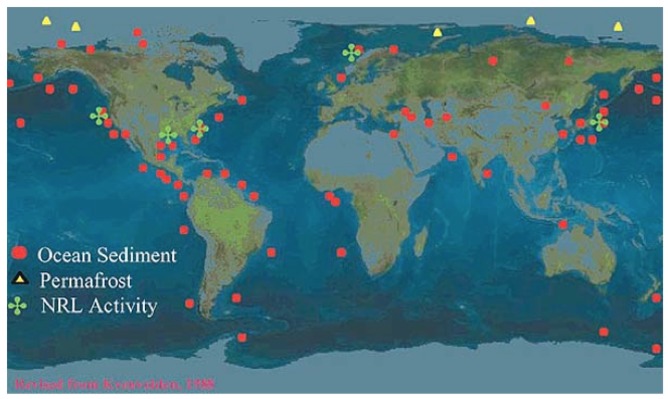
The sediments and bottom water beneath the world’s shallow oceans and lakes contain vast amounts of greenhouse gases: methane hydrates and methane clathrates (see Figure 1). In particular methane is concentrated in Arctic permafrost where the accumulation of organic matter in frozen soils covers about 24% of northern hemisphere continents (see Figure 2a) and is estimated to contain more than 900 billion tons of carbon.

Methane, a greenhouse gas more than 30 times more potent than CO2, is released from previously frozen soils when organic matter thaws and decomposes under anaerobic conditions (that is, without oxygen present).

Most of the current permafrost formed during or since the last ice age and can extend down to depths of more than 700 meters in parts of northern Siberia and Canada. Thawing of part of the permafrost has not yet been accounted for in climate projections.

The Siberian permafrost is in particular danger. A large region called the Yedoma could undergo runaway decomposition once it starts to melt. This is because elevated temperatures cause microbes in the soil to decompose, which causes heat, which creates a self-amplifying process.

Figure 1: Global distribution of methane hydrate deposits on the ocean floor. Naval Research Laboratory

Palaeoclimate studies of stalagmite cave deposits across Siberia indicate they grew faster during the warm periods 424,000 and 374,000 years ago, due to permafrost melt. At that time, mean global temperatures rose by approximately 1.5 degrees Celsius above pre-industrial temperatures. Thus Vaks et al state: “Growth at that time indicates that global climates only slightly warmer than today are sufficient to thaw extensive regions of permafrost.”

Evidence of melting of permafrost has also been reported from the dry valleys of Antarctica, where development of thermokarst (small surface hummocks formed as ice-rich permafrost thaws) has been reported, reaching a rate about 10 times that of the last ~10,000 years.

The mean temperature of the continents has already increased by about 1.5C. With sulphur aerosols masking some of the warming, the real figure may be closer to 2C.

Figure 2a: Vulnerable carbon sinks. CSIRO Global Carbon Project

Figure 2b: Global average abundances of
carbon 
dioxide and methane 1978-2011
Arctic air temperatures are expected to increase at roughly twice the global rate. A global temperature increase of 3C means a 6C rise in the Arctic, resulting in an irreversible loss of anywhere between 30 to 85% of near-surface permafrost. According to the United Nations, warming permafrost could emit 43 to 135 billion ton CO2 (GtCO2) equivalent by 2100, and 246 to 415 GtCO2 by 2200.
The geologically unprecedented rate of CO2 rise (~2.75 ppm/year during June 2012-2013) may result in faster permafrost collapse.

Already measurements along the Siberian shelf uncover enhanced methane release. In 2010 a Russian marine survey conducted more than 5000 observations of dissolved methane showing that more than 80% of East Siberian shelf bottom waters and more than 50% of surface waters are supersaturated with methane. Atmospheric methane levels (during glacial periods: 300–400 parts per billion; during interglacial periods: 600–700 ppb) have recently reached 1850 ppb – the highest in 400,000 years (see Figure 2b).

Hansen et al estimate that the rise of CO2 forcing between 1750 and 2007 has already committed the atmosphere to between +2 and +3 degrees Celsius, currently mitigated in part by sulphur aerosols.

Figure 3: Change in average annual land surface temperature since 1750. Berkeley Temperatures
Hansen refers to the “Venus Syndrome”, drawing an analogy between the enrichment of Venus’ atmosphere in CO2 (its atmosphere is 96.5% CO2 and its surface temperature is 462C) and potential terrestrial runaway greenhouse effects. This needs to be placed in context.

On Earth, weathering processes and oceans draw down the bulk of atmospheric CO2 to be deposited as carbonates. It’s therefore impossible for Earth to develop Venus-like conditions. But the onset of a hyperthermal – a huge release of carbon such as happened during the Paleocene-Eocene Thermal Maximum 55 million years ago, with an attendant mass extinction of species – is possible.

Figure 4. Estimates of fossil fuel resources and equivalent atmospheric CO2 levels, including (1) emissions to date; (2) estimated reserves, and (3) recoverable resources (1 ppm CO2 ~ 2.12 GtC). Hansen, 2012, figure 1; http://www.columbia.edu/~jeh1/mailings/2012/20120127_CowardsPart1.pdf

Extraction and combustion of the current fossil fuel reserves (more than 20,000 billion tonnes of carbon – Figure 4) would inevitably lead to a hyperthermal commensurate with or exceeding the PETM. If that happens, CO2 would rise to above 500ppm (see figure 4), temperature would rise by about 5C (figure 5) and the polar ice sheets would melt – it’s a future we could face if emissions continue to accelerate.

Figure 5: Growth in CO2 and CO2 equivalent (CO2+CH4) during the Pleistocene and the Holocene. IPCC AR4

Not that the above features too much in the Australian elections, where the reality of climate change has been replaced with pseudoscience notions, including by some who have not consulted basic climate science text books, and by hip-pocket-nerve terms such as “carbon tax”, “emission trading scheme” or “direct action”. The proposed 5% reduction in emissions relative to the year 2000 represent no more than climate window dressing.

Nor are coal exports mentioned too often, despite current exports and planned future exports, which represent carbon emissions tracking toward an order of magnitude higher than local emissions.

According to Dr Adam Lucas of the Science and Technology Studies Program at University of Wollongong, Australia (with ~0.3% of the global population) currently contributes domestic emissions of about 1.8% of global emissions. The total domestic and overseas consumption of Australian coal is responsible for more than 2% of global emissions. Plans to triple or even quadruple coal export volumes over the next 10 years would raise Australia’s total contribution to global GHG emissions to toward 9% to 11% by 2020 – an order of magnitude commensurate with that of Middle East oil.

Which places the “Great moral challenge of our generation” in perspective.

Andrew Glikson does not work for, consult to, own shares in or receive funding from any company or organisation that would benefit from this article, and has no relevant affiliations.

The Conversation
This article was earlier published at The Conversation.