Showing posts with label university. Show all posts

Tuesday, June 17, 2014

The University as big business:


The case of King's College London


© www.CartoonStock.com


King's College London is in the news for all the wrong reasons. In a document full of weasel words ('restructuring', 'consultation exercise'), staff in the schools of medicine and biomedical sciences, and the Institute of Psychiatry were informed last month that 120 of them were at risk of redundancy. The document was supposed to be confidential but was leaked to David Colquhoun who has posted a link to it on his blog.  This isn't the first time KCL has been in the news for its 'robust' management style. A mere four years ago, a similar though smaller purge was carried out at the Institute of Psychiatry, together with a major divestment in Humanities at KCL.


Any tale of redundancies on such a scale is a human tragedy, whether it be in a car factory or a University. But the two cases are not entirely parallel. For a car factory, the goal of the business is to make a profit. A sensible employer will try to maintain a cheerful and committed workforce, but ultimately they may be sacrificed if it proves possible to cut costs by, for instance, getting machines to do jobs that were previously done by people. The fact that a University is adopting that approach – sacking its academic staff to improve its bottom line – is an intellectual as well as a human tragedy. It shows how far we have moved towards the identification of universities with businesses.


Traditionally, a university was regarded as an institution whose primary function was the furtherance of learning and knowledge. Money was needed to maintain the infrastructure and pay the staff, but the money was a means to an end, not an end in itself. However, it seems that this quaint notion is now rejected in favour of a model of a university whose success is measured in terms of its income, not in terms of its intellectual capital.


The opening paragraph of the 'consultation document' is particularly telling: "King’s has built a reputation for excellence and has established itself as a world class university. Our success has been built on growing research volumes in key areas, improving research quality, developing our resources and offering quality teaching to attract the best students in an increasingly competitive environment." Note there is no mention of the academic staff of the institution. They are needed, of course, to "grow research volumes" (ugh!), just as factory workers are needed to manufacture cars. But they aren't apparently seen as a key feature of a successful academic institution. Note too the emphasis is on increasing the amount of research rather than research quality.


The most chilling feature of the document is the list of criteria that will be used to determine which staff are 'at risk'.  You are safe if you play a key role in teaching, or if you have grant income that exceeds a specified amount, dependent on your level of seniority.

What's wrong with this? Well, here are four points just for starters:


1. KCL management justifies its actions as key for "maintaining and improving our position as one of the world’s leading institutions". Sorry, I just don't get it. You don't improve your position by shedding staff, creating a culture of fear, and deterring research superstars from applying for positions in your institution in future.


2. The 'restructuring' treats individual scientists as islands. The Institute of Psychiatry has over the years built up a rich research community, where there are opportunities for people to bounce ideas off each other and bring complementary skills to tackling difficult problems. Making individuals redundant won't just remove an expense from the KCL balance sheet – it will also affect the colleagues of those who are sacked. 


3. As I've argued previously, the use of research income as a proxy measure of research excellence distorts and damages science. It provides incentives for researchers to get grants for the sake of it – the more numerous and more expensive the better. We end up with a situation where there is terrific waste because everyone has a massive backlog of unpublished work.


4. I suspect that part of the motivation behind the "restructuring" is in the hope that new buildings and infrastructure might reverse the poor showing of KCL in recent league tables of student satisfaction. If so, the move has backfired spectacularly. The student body at KCL has started a petition against the sackings, which has drawn attention to the issue worldwide.I urge readers to sign it.


Management at KCL just doesn't seem to get a very basic fact about running a university: Its academic staff are vital for the university's goal of achieving academic excellence. They need to be fostered, not bullied. One feels that if KCL were falling behind in a boat race, they'd respond by throwing out some of the rowers.


Saturday, January 26, 2013

An alternative to REF2014?


After blogging last week about use of journal impact factors in REF2014, many people have asked me what alternative I'd recommend. Clearly, we need a transparent, fair and cost-effective method for distributing funding to universities to support research. Those designing the REF have tried hard over the years to devise such a method, and have explored various alternatives, but the current system leaves much to be desired.


Consider the current criteria for rating research outputs, designed by someone with a true flair for ambiguity:


Rating Definition
4* Quality that is world-leading in terms of originality, significance and rigour
3* Quality that is internationally excellent in terms of originality, significance and rigour but which falls short of the highest standards of excellence
2* Quality that is recognised internationally in terms of originality, significance and rigour
1* Quality that is recognised nationally in terms of originality, significance and rigour


Since only 4* and 3* outputs will feature in the funding formula, then a great deal hinges on whether research is deemed “world-leading”, “internationally excellent” or “internationally recognised”. This is hardly transparent or objective. That’s one reason why many institutions want to translate these star ratings into journal impact factors. But substituting a discredited, objective criterion for a subjective criterion is not a solution.


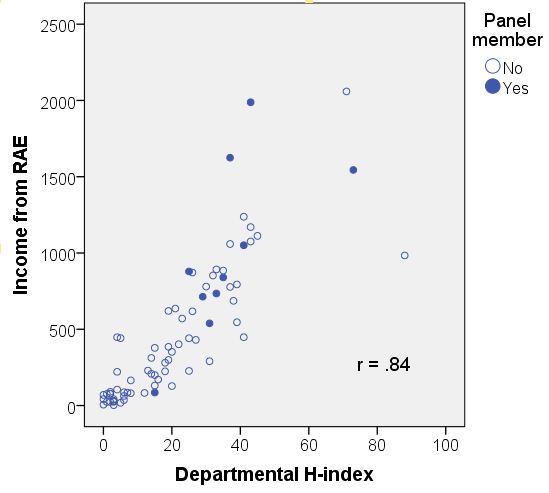
The use of bibliometrics was considered but rejected in the past. My suggestion is that we should reconsider this idea, but in a new version. A few months ago, I blogged about how university rankings in the previous assessment exercise (RAE) related to grant income and citation rates for outputs. Instead of looking at citations for individual researchers, I used Web of Science to compute an H-index for the period 2000-2007 for each department, by using the ‘address’ field to search. As noted in my original post, I did this fairly hastily and the method can get problematic in cases where a Unit of Assessment does not correspond neatly to a single department. The H-index reflected all research outputs of everyone at that address – regardless of whether they were still at the institution or entered for the RAE. Despite these limitations, the resulting H-index predicted the RAE results remarkably well, as seen in the scatterplot below, which shows H-index in relation to the funding level following from RAE. This is computed by number of full-time staff equivalents multiplied by the formula:

    .1 x 2* + .3  x 3* + .7 x 4*

(N.B. I ignored subject weighting, so units are arbitrary).


Psychology (Unit of Assessment 44), RAE2008 outcome by H-index

Yes, you might say, but the prediction is less successful at the top end of the scale, and this could mean that the RAE panels incorporated factors that aren’t readily measured by such a crude score as H-index. Possibly true, but how do we know those factors are fair and objective? In this dataset, one variable that accounted for additional variance in outcome, over and above departmental H-index, was whether the department had a representative on the psychology panel: if they did, then the trend was for the department to have a higher ranking than that predicted from the H-index. With panel membership included in the regression, the correlation (r) increased significantly from .84 to .86, t = 2.82, p = .006. It makes sense that if you are a member of a panel, you will be much more clued up than other people about how the whole process works, and you can use this information to ensure your department’s submission is strategically optimal. I should stress that this was a small effect, and I did not see it in a handful of other disciplines that I looked at, so it could be a fluke. Nevertheless, with the best intentions in the world, the current system can’t ever defend completely against such biases.


So overall, my conclusion is that we might be better off using a bibliometric measure such as a departmental H-index to rank departments. It is crude and imperfect, and I suspect it would not work for all disciplines – especially those in the humanities. It relies solely on citations, and it's debatable whether that is desirable. But for sciences, it seems to be pretty much measuring whatever the RAE was measuring, and it would seem to be the lesser of various possible evils, with a number of advantages compared to the current system. It is transparent and objective, it would not require departments to decide who they do and don’t enter for the assessment, and most importantly, it wins hands down on cost-effectiveness. If we'd used this method instead of the RAE, a small team of analysts armed with Web of Science should be able to derive the necessary data in a couple of weeks to give outcomes that are virtually identical to those of the RAE.  The money saved both by HEFCE and individual universities could be ploughed back into research. Of course, people will attempt to manipulate whatever criterion is adopted, but this one might be less easily gamed than some others, especially if self-citations from the same institution are excluded.


It will be interesting to see how well this method predicts RAE outcomes in other subjects, and whether it can also predict results from the REF2014, where the newly-introduced “impact statement” is intended to incorporate a new dimension into assessment.

Sunday, July 15, 2012

The devaluation of low-cost psychological research


Psychology encompasses a wide range of subject areas,
including social, clinical and developmental psychology, cognitive psychology
and neuroscience. The costs of doing different types of psychology vary hugely.
If you just want to see how people remember different types of material, for
instance, or test children's understanding of numerosity, this can be done at very
little cost. For most of the psychology I did as an undergraduate, data
collection did not involve complex equipment, and data analysis was pretty
straightforward - certainly well within the capabilities of a modern desktop
computer. The main cost for a research proposal in this area would be for staff
to do data collection and analysis. Neuroscience, however, is a different
matter. Most kinds of brain imaging require not only expensive equipment, but
also a building to house it and staff to maintain it, and all or part of these
costs will be passed on to researchers. Furthermore, data analysis is usually
highly technical and complex, and can take weeks, or even months, rather than
hours. A project that involves neuroimaging will typically cost orders of
magnitude more than other kinds of psychological research.


In academic research, money follows money. This is quite
explicit in funding systems that reward an institution in proportion to their
research income. This makes sense: an institution that is doing costly research
needs funding to support the infrastructure for that research. The problem is
that the money, rather than the research, can become the indicator of success. Hiring
committees will scrutinise CVs for evidence of ability to bring in large
grants. My guess is that, if choosing between one candidate with strong
publications and modest grant income vs. another with less influential
publications and large grant income, many would favour the latter.
Universities, after all, have to survive in a tough financial climate, and so
we are all exhorted to go after large grants to help shore up our institution's
income. Some Universities have even taken to firing people who don't bring in
the expected income. This means that cheap cost-effective research in
traditional psychological areas will be devalued relative to more expensive
neuroimaging.


I have no quarrel, in principle, with psychologists doing
neuroimaging studies - some of my best friends are neuroimagers -  and it is important that if good science is to be done in
this area that it should be properly funded. I am uneasy, though, about an
unintended consequence of the enthusiasm for neuroimaging, which is that it has
led to a devaluation of the other kinds of psychological research. I've been
reading Thinking Fast and Slow,
by Daniel Kahneman, a psychologist who has the rare distinction of
being a Nobel Laureate. This is just one example of a psychologist who has made major advances without using brain scanners. I couldn't help thinking that Kahneman would not fare
well in the current academic climate, because his experiments were simple,
elegant ... and inexpensive.


I've suggested previously that systems of academic rewards
need to be rejigged to take into account not just research income and
publication outputs, but the relationship between the two. Of course, some
kinds of research require big bucks, but large-scale grants are not always
cost-effective. And on the other side of the coin, there are people who do
excellent, influential work on a small budget.


I thought I'd see if it might be possible to get some hard
data on how this works in practice. I used data for Psychology Departments from
the last Research Assessment Exercise (RAE), from this website, and matched
this up against citation counts for publications that came out in the same time
period (2000-2007) from Web of Knowledge. The latter is a bit tricky, and I'm
aware that figures may contain inaccuracies, as I had to search by address,
using the name of the institution coupled with the words Psychology and UK. This will miss articles that don't have these words in the address. Also when double-checking the numbers, I  found that for a search by address, results can fluctuate from one occasion to the next. For these reasons, I'd urge readers to treat the results with caution, and
I won't refer to institutions by name. Note too that though I restrict consideration to articles between 2000-2007, the citations extend
beyond the period when the RAE was completed. Web of Knowledge helpfully gives
you an H-index for the institution if you ask for a citation report, and this
is what I report here, as it is more stable across repeated searches than the citation count. Figure 1 shows how research income for a department
relates to its H-index, just for those institutions deemed research active,
which I defined as having a research income of at least £500K over the reporting
period. The overall RAE rating is colour-coded into bandings, and the symbol denotes
whether or not the departmental submission mentions neuroimaging as an
important part of its work. 


Data from RAE and Web of Knowledge: treat with caution!


Several features are seen in these data, and most are
unsurprising:


  • Research income and H-index are positively correlated, r =
    .74 (95%CI .59-.84) as we would expect. Both variables are correlated with the
    number of staff entered in the RAE, but the correlation between them remains
    healthy when this factor is partialled out, r = .61 (95%CI .40-.76).

  • Institutions coded as doing neuroimaging have bigger grants: after taking into account differences in number of staff, the mean income
    for departments with neuroimaging was £7,428K and for those without it was
    £3,889K (difference significant at p = .01).

  • Both research income and H-index are predictive of RAE
    rankings: the correlations are .68 (95% CI .50-.80) for research income and .79
    (95% CI .66-.87) for H-index, and together they account for 80% of the variance
    in rankings. We would not expect perfect prediction, given that the RAE committee
    went beyond metrics to assess aspects of research quality not
    reflected in citations or income. And in addition, it must be noted that the
    citations counted here are for all researchers at a departmental address, not
    just those entered in the RAE.


A point of concern to me in these data, though, is the wide
spread in H-index seen for those institutions with the highest levels of grant
income. If these numbers are accurate, some departments are using their
substantial income to do influential work, while others seem to achieve no more
than other departments with much less funding. There may be reasonable
explanations for this - for instance, a large tranche of funding may have been
awarded in the RAE period but not had time to percolate through to
publications. But nevertheless, it adds to my concern that we may
be rewarding those who chase big grants without paying sufficient attention to
what they do with the funding when they get it.


What, if anything, should we do about this? I've toyed in
the past with the idea of a cost-efficiency metric (e.g. citations divided by
grant income), but this would not work as a basis for allocating funds, because
some types of research are intrinsically more expensive than others. In
addition, it is difficult to get research funding, and success in this arena is
in itself an indicator that the researchers have impressed a tough committee of
their peers. So, yes, it makes sense to treat level of research funding as one indicator
of an institution's research excellence when rating departments to determine
who gets funding. My argument is simply that we should be aware of the
unintended consequences if we rely too heavily on this metric. It would be nice
to see some kind of indicator of cost-effectiveness included in ratings of
departments alongside the more traditional metrics. In times of financial
stringency, it is particularly short-sighted to discount the contribution of
researchers who are able to do influential work with relatively scant
resources.