Saturday, March 9, 2013

High-impact journals: where newsworthiness trumps methodology


Here’s a paradox: Most scientists would give their eye teeth to get a paper in a high impact journal, such as Nature, Science, or Proceedings of the National Academy of Sciences. Yet these journals have had a bad press lately, with claims that the papers they publish are more likely to be retracted than papers in journals with more moderate impact factors. It’s been suggested that this is because the high impact journals treat newsworthiness as an important criterion for accepting a paper. Newsworthiness is high when a finding is both of general interest and surprising, but surprising findings have a nasty habit of being wrong.


A new slant on this topic was provided recently by a paper by Tressoldi et al (2013), who compared the statistical standards of papers in high impact journals with those of three respectable but lower-impact journals. It’s often assumed that high impact journals have a very high rejection rate because they adopt particularly rigorous standards, but this appears not to be the case. Tressoldi et al focused specifically on whether papers reported effect sizes, confidence intervals, power analysis or model-fitting. Medical journals fared much better than the others, but Science and Nature did poorly on these criteria. Certainly my own experience squares with the conclusions of Tressoldi et al (2013), as I described in the course of discussion about an earlier blogpost.


Last week a paper appeared in Current Biology (impact factor = 9.65) with the confident title: “Action video games make dyslexic children read better.” It's a classic example of a paper that is on the one hand highly newsworthy, but on the other, methodologically weak. I’m not usually a betting person, but I’d be prepared to put money on the main effect failing to replicate if the study were repeated with improved methodology. In saying this, I’m not suggesting that the authors are in any way dishonest. I have no doubt that they got the results they reported and that they genuinely believe they have discovered an important intervention for dyslexia. Furthermore, I’d be absolutely delighted to be proved wrong: There could be no better news for children with dyslexia than to find that they can overcome their difficulties by playing enjoyable computer games rather than slogging away with books. But there are good reasons to believe this is unlikely to be the case.


An interesting way to evaluate any study is to read just the Introduction and Methods, without looking at Results and Discussion. This allows you to judge whether the authors have identified an interesting question and adopted an appropriate methodology to evaluate it, without being swayed by the sexiness of the results. For the Current Biology paper, it’s not so easy to do this, because the Methods section has to be downloaded separately as Supplementary Material. (This in itself speaks volumes about the attitude of Current Biology editors to the papers they publish: Methods are seen as much less important than Results). On the basis of just Introduction and Methods, we can ask whether the paper would be publishable in a reputable journal regardless of the outcome of the study.


On the basis of that criterion, I would argue that the Current Biology paper is problematic, purely on the basis of sample size. There were 10 Italian children aged 7 to 13 years in each of two groups: one group played ‘action’ computer games and the other was a control group playing non-action games (all games from Wii's Rayman Raving Rabbids - see here for examples). Children were trained for 9 sessions of 80 minutes per day over two weeks. Unfortunately, the study was seriously underpowered. In plain language, with a sample this small, even if there is a big effect of intervention, it would be hard to detect it. Most interventions for dyslexia have small-to-moderate effects, i.e. they improve performance in the treated group by .2 to .5 standard deviations. With 10 children per group, the power is less than .2, i.e. there’s a less than one in five chance of detecting a true effect of this magnitude. In clinical trials, it is generally recommended that the sample size be set to achieve power of around .8. This is only possible with a total sample of 20 children if the true effect of intervention is enormous – i.e. around 1.2 SD, meaning there would be little overlap between the two groups’ reading scores after intervention. Before doing this study there would have been no reason to anticipate such a massive effect of this intervention, and so use of only 10 participants per group was inadequate. Indeed, in the context of clinical trials, such a study would be rejected by many ethics committees (IRBs) because it would be deemed unethical to recruit participants for a study which had such a small chance of detecting a true effect.


But, I hear you saying, this study did find a significant effect of intervention, despite being underpowered. So isn’t that all the more convincing? Sadly, the answer is no. As Christley (2010) has demonstrated, positive findings in underpowered studies are particularly likely to be false positives when they are surprising – i.e., when we have no good reason to suppose that there will be a true effect of intervention. This seems particularly pertinent in the case of the Current Biology study – if playing active computer games really does massively enhance children’s reading, we might have expected to see a dramatic improvement in reading levels in the general population in the years since such games became widely available.


The small sample size is not the only problem with the Current Biology study. There are other ways in which it departs from the usual methodological requirements of a clinical trial: it is not clear how the assignment of children to treatments was made or whether assessment was blind to treatment status, no data were provided on drop-outs, on some measures there were substantial differences in the variances of the two groups, no adjustment appears to have been made for the non-normality of some outcome measures, and a follow-up analysis was confined to six children in the intervention group. Finally, neither group showed significant improvement in reading accuracy, where scores remained 2 to 3 SD below the population mean (Tables S1 and S3): the group differences were seen only for measures of reading speed.


Will any damage be done? Probably not much – some false hopes may be raised, but the stakes are not nearly as high as they are for medical trials, where serious harm or even death can result from wrong results. There is concern, however, that quite apart from the implications for families of children with reading problems, there is another issue here, about the publication policies of high-impact journals. These journals wield immense power. It is not overstating the case to say that a person’s career may depend on having a publication in a journal like Current Biology (see this account – published, as it happens, in Current Biology!). But, as the dyslexia example illustrates, a home in a high-impact journal is no guarantee of methodological quality. Perhaps this should not surprise us: I looked at the published criteria for papers on the websites of Nature, Science, PNAS and Current Biology. None of them mentioned the need for strong methodology or replicability; all of them emphasised “importance” of the findings.


Methods are not a boring detail to be consigned to a supplement: they are crucial in evaluating research. My fear is that the primary goal of some journals is media coverage, and consequently science is being reduced to journalism, and is suffering as a consequence.


References


Brembs, B., & Munafò, M. R. (2013). Deep impact: Unintended consequences of journal rank. arXiv:1301.3748.


Christley, R. M. (2010). Power and error: increased risk of false positive results in underpowered studies. The Open Epidemiology Journal, 3, 16-19.


Halpern, S. D.,  Karlawish, J. T, & Berlin, J. A. (2002). The continuing unethical conduct of underpowered clinical trials. Journal of the American Medical Association, 288(3), 358-362. doi: 10.1001/jama.288.3.358


Lawrence, P. A. (2007). The mismeasurement of science. Current Biology, 17(15), R583-R585. doi: 10.1016/j.cub.2007.06.014


Tressoldi, P., Giofré, D., Sella, F., & Cumming, G. (2013). High Impact = High Statistical Standards? Not Necessarily So. PLoS ONE, 8 (2) DOI: 10.1371/journal.pone.0056180

Saturday, February 9, 2013

Postgraduate education: time for a rethink


The Master said: "I
never refuse to teach anyone, not even those so lowly they come offering
nothing more but a few strips of dried meat."   


Confucius, 


The Analects 7.7


It’s that time of year again when hopeful applicants are being interviewed for postgraduate places in the UK. The bar is set ever higher: gone are the days when a good first degree would guarantee you an interview. In my own department, the sad reality is that even for those with stellar CVs, the amount of funding is pitifully small. If you’re really smart and motivated and determined to get a doctorate, the only way forward may be self-funding. But here’s the problem: student loans will cover undergraduate but not postgraduate study. If you’re on a full-time course, it can be hard to find a job that would begin to cover your costs. So the only option may be to find friends or relatives willing to give or loan you the money. For a doctorate in Experimental Psychology at Oxford (UK and EU students), this comes to £6,659 per annum in fees, plus you have to demonstrate you have £12,900 per annum for living costs. And for overseas students, the fees are nearly three times as much.


At undergraduate level, huge efforts have been made to widen access and to ensure that family background is no barrier to studying at Oxford. Indeed, there have even been complaints that there is a bias against public school applicants. But at postgraduate level, everything is different.


This point has been forcefully brought to the attention of academics here in Oxford because of a legal challenge that was issued last month October by a potential graduate student, Damien Shannon. Mr Shannon had been accepted for an MSc in economic and social history. He obtained a bank loan to cover fees, but was not allowed to take up his place because he could not demonstrate that he had £21,082 to cover living costs. Although Mr Shannon is suing St Hugh’s College, the monetary undertaking is part of the University’s requirements and not specific to any one college. He is challenging this requirement, on the grounds that the financial demands are unreasonable and discriminate against poorer students. Shannon argues that it is perfectly possible to live in Oxford on less than £12K per annum; he objects to the fact that the cost of living level has been set on the assumption that students at Oxford will indulge in a lifestyle that involves “socialising and dining in college”.


I disagree with Shannon’s specific argument, but I’m glad he’s forced this issue into the open. He’s creating a diversion from the real issues by implying that Oxford only wants postgraduates who can sustain some kind of Brideshead Revisited lifestyle. This is just plain daft. If you are going to supervise someone, at Oxford or anywhere else, what you are looking for are the qualities specified by Chris Chambers: “Intelligence, discipline, creativity, rationalism, stubbornness – and sheer nerdiness”. Note that poshness, affluence and a taste for claret don’t feature in the list. Most of us prefer students who can stand on their own two feet without depending on donations from rich parents. But what we definitely don’t want are students whose studies are disrupted by malnutrition, financial stress and the tiredness that comes from trying to do postgraduate work while holding down a job. It’s taxing enough doing postgraduate studies without being in penury, and I reckon that the University’s cost-of-living estimate  is both reasonable in scale and motivated by a consideration for student welfare, not by a desire to exclude the poor.


Nevertheless, under the current system, it’s undeniable that the poor are excluded, and, with students now amassing large debts during undergraduate courses this trend is exacerbated. This can only be bad for social mobility. Employers are increasingly demanding qualifications beyond a first degree: you may not even get shortlisted for a job unless you have at least a Master’s level qualification. On the basis of analysis of longitudinal data from the National Child Development Study and the British Cohort Study, Lindley and Machin (2012) concluded: "It is very clear that the individuals who have done better in terms of wages are those who have acquired higher education qualifications. In turn, the acquisition of higher qualifications has become more skewed towards people from wealthier backgrounds."


So what’s the solution? Perhaps we need to rethink how we structure our educational system. The current model imposes a chasm between studying and employment. The University of Oxford does not offer part-time degrees*(see below!), and discourages students from taking on any but minimal paid work. Contrast this with Birkbeck College London, where my mother studied for both undergraduate and postgraduate degrees in the 1960s, while working as a secretary. (She was a mature student, and mealtimes in our household were greatly enlivened by regular “Educating Rita” moments, as when she was first introduced to Kafka :“I just don’t get it. There’s this man who’s turned into a cockroach. I mean, it’s just completely stupid!”).


I don’t see Oxford introducing part-time courses or evening study any time soon. Apart from creating administrative complications, especially in the context of the college system, it would go against an ethos that values the idea of intense scholarship, with the student free from worldly distractions. I’ve always thought that here in the UK our postgraduates have a huge advantage because they can immerse themselves entirely in research, allowing them to complete a doctorate some two to three years ahead of their North American contemporaries. I’d be sorry to see the option for full-time scholarship disappear: there is something special that occurs when a person is entirely free to focus just on academic study, to the exclusion of everything else. But I do think we need other options, especially in view of the growing financial pressures on students.


The introduction of more flexible degrees could make a big difference to students like Damien Shannon, because they would make it feasible to fund oneself through a degree. I can see benefits, too, for those who want to combine an academic degree with child-rearing. We have for many years had models in the UK for institutions offering part-time degrees, evening courses, sandwich courses and distance learning, yet these are regarded as outside the mainstream. My suggestion is that our top universities need to think seriously about offering such alternative modes of study alongside traditional degree courses if we really want to make postgraduate education accessible to all of those who are able to benefit from it.

Reference
Lindley, J., & Machin, S. (2012). The Quest for More and More Education: Implications for Social Mobility* Fiscal Studies, 33 (2), 265-286 DOI: 10.1111/j.1475-5890.2012.00161.x


*This is what I love about blogging - within minutes of posting this blog, I've been corrected by Tristram - see first comment - Oxford DOES offer some part-time postgrad degrees already! 


PS 28/3/2013

The dispute between Damien Shannon and Oxford University has been resolved. Oxford University is to review its procedures regarding financial guarantees. Mr Shannon has been offered a postgraduate place from October 2013. I'll be following the review process with great interest.


Saturday, January 26, 2013

An alternative to REF2014?


After blogging last week about use of journal impact factors in REF2014, many people have asked me what alternative I'd recommend. Clearly, we need a transparent, fair and cost-effective method for distributing funding to universities to support research. Those designing the REF have tried hard over the years to devise such a method, and have explored various alternatives, but the current system leaves much to be desired.


Consider the current criteria for rating research outputs, designed by someone with a true flair for ambiguity:


Rating Definition
4* Quality that is world-leading in terms of originality, significance and rigour
3* Quality that is internationally excellent in terms of originality, significance and rigour but which falls short of the highest standards of excellence
2* Quality that is recognised internationally in terms of originality, significance and rigour
1* Quality that is recognised nationally in terms of originality, significance and rigour


Since only 4* and 3* outputs will feature in the funding formula, then a great deal hinges on whether research is deemed “world-leading”, “internationally excellent” or “internationally recognised”. This is hardly transparent or objective. That’s one reason why many institutions want to translate these star ratings into journal impact factors. But substituting a discredited, objective criterion for a subjective criterion is not a solution.


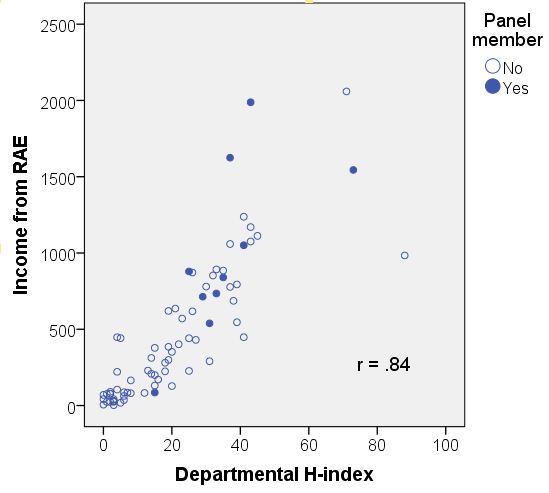
The use of bibliometrics was considered but rejected in the past. My suggestion is that we should reconsider this idea, but in a new version. A few months ago, I blogged about how university rankings in the previous assessment exercise (RAE) related to grant income and citation rates for outputs. Instead of looking at citations for individual researchers, I used Web of Science to compute an H-index for the period 2000-2007 for each department, by using the ‘address’ field to search. As noted in my original post, I did this fairly hastily and the method can get problematic in cases where a Unit of Assessment does not correspond neatly to a single department. The H-index reflected all research outputs of everyone at that address – regardless of whether they were still at the institution or entered for the RAE. Despite these limitations, the resulting H-index predicted the RAE results remarkably well, as seen in the scatterplot below, which shows H-index in relation to the funding level following from RAE. This is computed by number of full-time staff equivalents multiplied by the formula:

    .1 x 2* + .3  x 3* + .7 x 4*

(N.B. I ignored subject weighting, so units are arbitrary).


Psychology (Unit of Assessment 44), RAE2008 outcome by H-index

Yes, you might say, but the prediction is less successful at the top end of the scale, and this could mean that the RAE panels incorporated factors that aren’t readily measured by such a crude score as H-index. Possibly true, but how do we know those factors are fair and objective? In this dataset, one variable that accounted for additional variance in outcome, over and above departmental H-index, was whether the department had a representative on the psychology panel: if they did, then the trend was for the department to have a higher ranking than that predicted from the H-index. With panel membership included in the regression, the correlation (r) increased significantly from .84 to .86, t = 2.82, p = .006. It makes sense that if you are a member of a panel, you will be much more clued up than other people about how the whole process works, and you can use this information to ensure your department’s submission is strategically optimal. I should stress that this was a small effect, and I did not see it in a handful of other disciplines that I looked at, so it could be a fluke. Nevertheless, with the best intentions in the world, the current system can’t ever defend completely against such biases.


So overall, my conclusion is that we might be better off using a bibliometric measure such as a departmental H-index to rank departments. It is crude and imperfect, and I suspect it would not work for all disciplines – especially those in the humanities. It relies solely on citations, and it's debatable whether that is desirable. But for sciences, it seems to be pretty much measuring whatever the RAE was measuring, and it would seem to be the lesser of various possible evils, with a number of advantages compared to the current system. It is transparent and objective, it would not require departments to decide who they do and don’t enter for the assessment, and most importantly, it wins hands down on cost-effectiveness. If we'd used this method instead of the RAE, a small team of analysts armed with Web of Science should be able to derive the necessary data in a couple of weeks to give outcomes that are virtually identical to those of the RAE.  The money saved both by HEFCE and individual universities could be ploughed back into research. Of course, people will attempt to manipulate whatever criterion is adopted, but this one might be less easily gamed than some others, especially if self-citations from the same institution are excluded.


It will be interesting to see how well this method predicts RAE outcomes in other subjects, and whether it can also predict results from the REF2014, where the newly-introduced “impact statement” is intended to incorporate a new dimension into assessment.

Saturday, January 19, 2013

Journal Impact Factors and REF 2014


In 2014, British institutions of Higher Education are to be evaluated in the Research Excellence Framework (REF), an important exercise on which their future funding depends. Academics are currently undergoing scrutiny by their institutions to determine whether their research outputs are good enough to be entered in the REF. Outputs are to be assessed in terms of  "‘originality, significance and rigour’, with reference to international research quality standards."

Here's what the REF2014 guidelines say about journal impact factors:


"No sub-panel will make any use of journal impact factors, rankings, lists or the perceived standing of publishers in assessing the quality of research outputs."


Here are a few sources that explain why it is a bad idea to use impact factors to evaluate individual research outputs:

Stephen Curry's blog

David Colquhoun letter to Nature

Manuscript by Brembs & Munafo on "Unintended consequences of journal rank"

Editage tutorial


Here is some evidence that the REF2014 statement on impact factors is being widely ignored:


Jenny Rohn Guardian blogpost


And here's a letter I wrote yesterday to the representatives of RCUK who act as observers on REF panels about this. I'll let you know if I get a reply.


18th January 2013


To: Ms Anne-Marie Coriat: Medical Research Council   
Dr Alf Game: Biotechnology and Biological Sciences Research Council   
Dr Alison Wall: Engineering and Physical Sciences Research Council   
Ms Michelle Wickendon: Natural Environment Research Council   
Ms Victoria Wright: Science and Technology Facilities Council   
Dr Fiona Armstrong: The Economic and Social Research Council    
Mr Gary Grubb: Arts and Humanities Research Council    


Dear REF2014 Observers,

I am contacting you because a growing number of academics are expressing concerns that, contrary to what is stated in the REF guidelines, journal impact factors are being used by some Universities to rate research outputs. Jennifer Rohn raised this issue here in a piece on the Guardian website last November:
http://www.guardian.co.uk/science/occams-corner/2012/nov/30/1


I have not been able to find any official route whereby such concerns can be raised, and I have evidence that some of those involved in the REF, including senior university figures and REF panel members, regard it as inevitable and appropriate that journal impact factors will be factored in to ratings - albeit as just one factor among others. Many, perhaps most, of the academics involved in panels and REF preparations grew up in a climate where publication in a high impact journal was regarded as the acme of achievement. Insofar as there are problems with the use of impact factors, they seem to think the only difficulty is the lack of comparability across sub-disciplines, which can be adjusted for. Indeed, I have been told that it is naïve to imagine that this statement should be taken literally: "No sub-panel will make any use of journal impact factors, rankings, lists or the perceived standing of publishers in assessing the quality of research outputs." 


Institutions seem to vary in how strictly they are interpreting this statement and this could lead to serious problems further down the line. An institution that played by the rules and submitted papers based only on perceived scientific quality might challenge the REF outcome if they found the panel had been basing ratings on journal impact factor. The evidence for such behaviour could be reconstructed from an analysis of outputs submitted for the REF.


I think it is vital that RCUK responds to the concerns raised by Dr Rohn to clarify the position on journal impact factors and explain the reasoning behind the guidelines on this. Although the statement seems unambiguous, there is a widespread view that the intention is only to avoid slavish use of impact factors as a sole criterion, not to ban their use altogether. If that is the case, then this needs to be made explicit. If not, then it would be helpful to have some mechanism whereby academics could report institutions that flout this rule.

Yours sincerely

(Professor) Dorothy Bishop


Reference

Colquhoun, D. (2003). Challenging the tyranny of impact factors Nature, 423 (6939), 479-479 DOI: 10.1038/423479a


P.S. 21/1/13

This post has provoked some excellent debate in the Comments, and also on Twitter. I have collated the tweets on Storify here, and the Comments are below. They confirm that there are very divergent views out there about whether REF panels are likely to, or should, use journal impact factor in any shape or form. They also indicate that this issue is engendering high levels of anxiety in many sections of academia.


P.P.S. 30/1/13

REPLY FROM HEFCE


I now have a response from Graeme Rosenberg, REF Manager at HEFCE, who kindly agreed that I could post relevant content from his email here. This briefly explains why impact factors are disallowed for REF panels, but notes that institutions are free to flout this rule in their submissions, at their own risk. The text follows:


I think your letter raises two sets of issues, which I will respond to in turn. 


The REF panel criteria state clearly that panels will not use journal impact factors in the assessment. These criteria were developed by the panels themselves and we have no reason to doubt they will be applied correctly. The four main panels will oversee the work of the sub-panels throughout the assessment process, and it part of the main panels' remit to ensure that all sub-panels apply the published criteria. If there happen to be some individual panel members at this stage who are unsure about the potential use of impact factors in the panels' assessments, the issue will be clarified by the panel chairs when the assessment starts. The published criteria are very clear and do not leave any room for ambiguity on this point. 


The question of institutions using journal impact factors in preparing their submissions is a separate issue. We have stated clearly what the panels will and will not be using to inform their judgements. But institutions are autonomous and ultimately it is their decision as to what forms of evidence they use to inform their selection decisions. If they choose to use journal impact factors as part of the evidence, then the evidence for their decisions will differ to that used by panels. This would no doubt increase the risk to the institution of reaching different conclusions to the REF panels. Institutions would also do well to consider why the REF panels will not use journal impact factors - at the level of individual outputs they are a poor proxy for quality. Nevertheless, it remains the institution's choice.


Friday, January 11, 2013

Genetic variation and neuroimaging: some ground rules for reporting research


Those who follow me on Twitter may have
noticed signs of tetchiness in my tweets over the past few weeks. In the course
of writing a review article, I’ve been reading papers linking genetic variants
to language-related brain structure and function. This has gone more slowly than I expected for
two reasons. First, the literature gets ever more complicated and technical:
both genetics and brain imaging involve huge amounts of data, and new methods
for crunching the numbers are developed all the time. If you really want to understand
a paper, rather than just assuming the Abstract is accurate, it can be a long,
hard slog, especially if, like me, you are neither a geneticist nor a
neuroimager. That’s understandable and perhaps unavoidable. The other reason,
though, is less acceptable. For all their complicated methods, many of the
papers in this area fail to tell the reader some important and quite basic
information. This is where the tetchiness comes in. Having burned my brains out
trying to understand what was done, I then realise that I have no idea about
something quite basic like the sample size. The initial assumption is that I’ve
missed it, and so I wade through the paper again, and the Supplementary Material, looking
for the key information. Only when I’m absolutely certain that it’s not there,
am I reduced to writing to the authors for the information. So
this is a plea – to authors, editors and reviewers. If a paper is concerned
with an association between a genetic variant and a phenotype (in my case the
interest is in neural phenotypes, but I suspect this applies more widely) then
could we please ensure that the following information is clearly reported in
the Methods or Results section


1. What genetic variant are we talking about?
You might think this is very simple, but it’s not: for instance, one of the
genes I’m interested in is CNTNAP2, which has been associated with a range of
neurodevelopmental disorders, especially those affecting language. The evidence
for a link between CNTNAP2 and developmental disorders comes from studies that
have examined variation in single-nucleotide polymorphisms or SNPs. These are
segments of DNA that are useful in revealing differences between people because
they are highly variable. DNA is composed of four bases, C, T, G, and A in
paired strands. So for instance, we might have a locus where some people have
two copies of C, some have two copies of T, and others have a C and a T. SNPs
are not  necessarily a functional part of
the gene itself – they may be in a non-coding region, or so close to a gene that
variation in the SNP co-occurs with variation in the gene. Many different SNPs
can index the same gene. So for CNTNAP2, Vernes et al (2008)tested 38 SNPs,
ten of which were linked to language problems. So we have to decide which SNP
to study – or whether to study all of them. And we have to decide how to do the
analysis. For instance, SNP rs2710102 can take the form CC, CT or TT. We could
look for a dose response effect (CC < CT < TT) or we could compare CC/CT with TT, or we could compare CC with CT/TT. Which of these we do may depend on whether prior research suggests the genetic effect is additive or dominant, but for brain imaging studies grouping can also be dictated by practical considerations: it’s usual to compare just two groups and to combine genotypes to give a reasonable sample size. If you’ve followed me so far, and you have some background in statistics, you will already be starting to see why this is potentially problematic. If the researcher can select from ten possible SNPs, and two possible analyses, the opportunities for finding spuriously ‘significant’ results are increased. If there are no directional predictions – i.e. we are just looking for a difference between two groups, but don’t have a clear idea of what type of difference will be associated with ‘risk’ – then the number of potentially ‘interesting’ results is doubled.


For CNTNAP2, I found two papers that had
looked at brain correlates of SNP rs2710102. Whalley et al (2011) found that adults
with the CC genotype had different patterns of brain activation from CT/TT
individuals. However, the other study, by Scott-van Zeeland et al (2010), treated
CC/CT as a risk genotype that was compared with TT. (This was not clear in the
paper, but the authors confirmed it was what they did).


 Four studies looked at another SNP -
rs7794745, on the basis that an increased risk of autism had been reported for
the T allele in males. Two of them (Tan et al, 2010; Whalley et al, 2010) compared TT vs TA/AA and two (Folia et al, 2011; Kos et al, 2012) compared
TT/TA with AA. In any case, the ground is rather cut from under the feet of
these researchers by a recent failure to replicate an association of this SNP
with autism (Anney et al, 2012).


2. Who are the participants? It’s not very
informative to just say you studied “healthy volunteers”. There are some types
of study where it doesn’t much matter how you recruited people. A study looking
at genetic correlates of cognitive ability isn’t one of them. Samples of
university students, for instance, are not representative of the general
population, and aren’t likely to include many people with significant language
problems.


3. How many people in the study had each type
of genetic variant?
And if subgroup analyses are reported, how many people in
each subgroup had each type of genetic variant? I've found that papers in top-notch journals often fail to provide this basic
information.


Why is this important? For a start, likelihood
of showing significant activation of a brain region will be affected by sample
size. Suppose you have 24 people with genotype A and 8 with genotype B. You
find significant activation of brain region X in those with genotype A, but not
for those with genotype B. If you don’t do an explicit statistical comparison
of groups (you should - but many people don’t) you may be misled into concluding that brain
activation is defective in genotype B – when in fact you just have low power to
detect effects in that group because it is so small.


In addition, if you don’t report the N, then
it’s difficult to get an idea of the effect size and confidence interval for
any effect that is reported. The reasons why this is optimal are
well-articulated here. This issue has been much discussed in psychology, but seems not to have
permeated the field of genetics, where reliance on p-values seems the norm. In
neuroimaging it gets particularly complicated, because some form of correction
for ‘false discovery’ will be applied when multiple comparisons are conducted. It’s
often hard to work out quite how this was done, and you can end up staring at
a table that shows brain regions and p-values, with only a vague idea of how
big a difference there actually is between groups.


 Most of the SNPs that are being used in brain studies are ones that
were found to be associated with a behavioural phenotype in large-scale genomic
studies where the sample size would include hundreds if not thousands of
individuals, so small effects could be detected. Brain-based studies often use
sample sizes that are relatively small, but some of them find large, sometimes
very large, effects. So what does that mean? The optimistic interpretation is
that a brain-based phenotype is much closer to the gene effect, and so gives
clearer findings. This is essentially 
the argument used by those who talk of ‘endophenotypes’ or ‘biomarkers’.
There is, however, an alternative, and much more pessimistic view, which is
that studies linking genotypes with brain measures are prone to generate false
positive findings, because there are too many places in the analysis pipeline
where the researchers have opportunities to pick and choose the analysis that
brings out the effect of interest most clearly. Neuroskeptic has a nice blogpost illustrating this well-known problem in
the neuroimaging area; matters are only made worse by uncertainty re SNP classification
(point 1).


A source of concern here is the
unpublishability of null findings. Suppose you did a study where you looked at,
say, 40 SNPs and a range of measures of brain structure, covering the whole
brain. After doing appropriate corrections for multiple comparisons, nothing is
significant. The sad fact is that your study is unlikely to find a home in a
journal. But is this right? After all, we don’t want to clutter up the
literature with a load of negative results. The answer depends on your sample
size, among other things. In a small sample, a null result might well reflect
lack of statistical power to detect a small effect. This is precisely why
people should avoid doing small studies: if you find nothing, it’s
uninterpretable. What we need are studies that allow us to say with confidence
whether or not there is a significant gene effect.


4. How do the genetic/neuroimaging results relate to cognitive measures in your sample?  Your notion that ‘underactivation of brain area
X’ is an endophenotype that leads to poor language, for instance, doesn’t look
very plausible if people who have such underactivation have excellent language skills. Out
of five papers on CNTNAP2 that I reviewed, three made no mention of cognitive measures,
one gathered cognitive data but did not report how it related to genotype or
brain measures, and only one provided some relevant, though sketchy, data.


5. Report negative findings. The other kind of
email I’ve been writing to people is one that says – could you please clarify
whether your failure to report on the relationship between X and Y was because
you didn’t do that analysis, or whether you did the analysis but failed to find
anything. This is going to be an uphill battle, because editors and reviewers
often advise authors to remove analyses with nonsignificant findings. This is a
very bad idea as it distorts the literature.


And last of all....


A final plea is not so much to journal
editors as to press officers. Please be aware that studies of common SNPs aren't the same as studies of rare genetic mutations. The genetic variants in the
studies I looked at were all relatively common in the general population, and so
aren't going to be associated with major brain abnormalities. Sensationalised
press releases can only cause confusion:


This release on the Scott van-Zeeland (2010) study described neuroimaging
findings from  CNTNAP2 variants that are found in over 70% of the population. It claims that:


  • “A gene variant tied to autism rewires the
    brain"


  • "Now we can begin to unravel the mystery
    of how genes rearrange the brain's circuitry, not only in autism but in many
    related neurological disorders."


  • “Regardless of their diagnosis, the children
    carrying the risk variant showed a disjointed brain. The frontal lobe was
    over-connected to itself and poorly connected to the rest of the brain”


  • "If we determine that the CNTNAP2
    variant is a consistent predictor of language difficulties, we could begin to
    design targeted therapies to help rebalance the brain and move it toward a path
    of more normal development."


Only at the end of the press release, are we
told that "One third of the population [sic: should be two thirds] carries this variant in its DNA.
It's important to remember that the gene variant alone doesn't cause autism, it
just increases risk." 


References


Anney, R., Klei, L.,
Pinto, D., Almeida, J., Bacchelli, E., Baird, G., . . . Devlin, B. .
Individual common variants exert weak effects on the risk for autism spectrum
disorders. Human Molecular Genetics, 21(21), 4781-4792. doi: 10.1093/hmg/dds301(2012)

V. Folia, C. Forkstam, M.
Ingvar, P. Hagoort, K. M. Petersson, Implicit artificial syntax processing:
Genes, preference, and bounded recursion. Biolinguistics 5,  (2011).


M. Kos et al., CNTNAP2
and language processing in healthy individuals as measured with ERPs. PLOS One
7,  (2012).

Scott-Van Zeeland, A., Abrahams, B., Alvarez-Retuerto, A., Sonnenblick, L., Rudie, J., Ghahremani, D., Mumford, J., Poldrack, R., Dapretto, M., Geschwind, D., & Bookheimer, S. (2010). Altered Functional Connectivity in Frontal Lobe Circuits Is Associated with Variation in the Autism Risk Gene CNTNAP2 Science Translational Medicine, 2 (56), 56-56 DOI: 10.1126/scitranslmed.3001344


G. C. Tan, T. F. Doke, J.
Ashburner, N. W. Wood, R. S. Frackowiak, Normal variation in fronto-occipital
circuitry and cerebellar structure with an autism-associated polymorphism of
CNTNAP2. Neuroimage 53, 1030 (2010).


Vernes, S. C., Newbury,
D. F., Abrahams, B., Winchester, L., Nicod, J., Groszer, M., . . . Fisher, S.  A functional genetic link between distinct developmental language
disorders. New England Journal of Medicine, 359, 2337-2345. (2008).


H. C. Whalley et al.,
Genetic variation in CNTNAP2 alters brain function during linguistic processing
in healthy individuals. Am. J. Med. Genet. B 156B, 941 (2011).